Blades ‘68 drags Doskvol kicking and screaming into the light
A different blade for a different play culture.


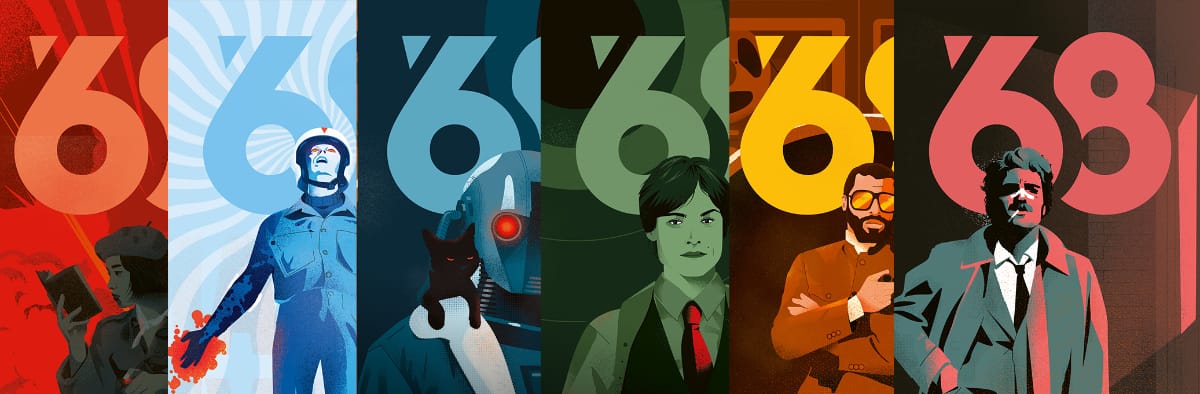
The very first line of Blades ‘68 by Tim Denee reads, “Blades ‘68 is a supplement for Blades in the Dark.” No disrespect to Denee, but I disagree. Blades ‘68 is a sequel. You can call this pedantic. I’ve been called a pedant before. But it’s true. Beyond the chronologically sequential nature of Blades ‘68 — which takes place 100 years ahead of the science-fantasy city of Doskvol, the canon setting within the Victorian/Industrial-Revolution-inspired Blades in the Dark — the various updates to the character-facing mechanics show a deep understanding of how people play Blades in the Dark, and explore new ways to leverage player investment within the game.
Fundamentally, yes, you need a basic understanding of Blades in the Dark to play Blades ‘68 and the essential rules surrounding action rolls — including position-effect-resolution mechanics, load, and flashbacks aren’t included — but a lot of the mechanics have been updated, and give the game a new play flavor. Blades ‘68 deliberately and artfully engages with the original text in a way that feels conversational, rather than deferential or curative. Reviewing the System Changes overview, most of the updates are tweaks done to how the world affects the player-characters (called operatives in Blades ‘68) rather than how the world is imagined and played within.
In my experience, games of Blades in the Dark typically live and die based on how holistically Doskvol is rendered – how many factions crawl the edges, how many debts are owed, and what spirits haunt the waterways. In a successful game, the manifestation of this city — with all its extremes — will naturally support enterprising players, allowing them to leverage every mechanic they have to succeed within the jostling factions, politics, and supernatural struggles. The playbooks are so keyed into the political and cultural concerns of a fictional Doskvol, that playing in another setting makes the game significantly more difficult to play, or makes it a different game entirely.
But something that’s key to Blades ‘68 is that the core of Doskvol is unchanged, even as corruption, magic, and technology have evolved with the times. Most of the rules adjustments, as I mentioned before, are the ways that players gain and lose power within the fiction. Rules are intrinsically expressions of power and agency. Blades ‘68 then becomes not just a game, but a narrative device that shows how cultural attitudes towards power have shifted over the course of a hundred years of Doskvol history. And because most of the system changes affect how players interact with the game, rather than how the game is fundamentally played, we can draw conclusions about how personal agency has shifted across time, both within the game and within our own play cultures.
Take Harm for example. In Blades in the Dark, both Moderate and Severe Harm carry mechanical penalties, either a dice pool disadvantage (- 1D6) and a requirement to take more stress if a player wants to perform any action without help. In Blades ‘68, Harm is a “fictional consideration that flows into effect, and carries no other mechanical penalties during a score.” When BitD was first being written, over ten years ago, storygames were experimenting with the balance of situational veracity with story-first gaming (an experiment that persists to this day). While Blades in the Dark encourages a lot of daring moves, those can be severely hampered if you take too much harm, which will likely lead to more harm, which means that players become more careful and protective of their characters. Denee’s adjustment shifts harm consequence to downtime. The result is a ruleset that tells players to do the cool thing now and deal with consequences later, rather than in the moment. Players are encouraged to keep pushing through the score, even if that means that there will be more complications after the play phase is wrapped up. A part of the contemporary culture of indie gaming is focused on improving the player experience at the table, and by deferring consequences of harm away from the direct, mechanical action, Blades 68 gives players — and characters — more choices in the scene and doesn’t allow momentum to drop in a heated moment.
Another way that Blades ‘68 is responding to play culture is the introduction of Keys and Deadlocks. Mechanically, these are another way to gain experience and they also replace the secondary Trauma harm track of Blades in the Dark. Trauma was a permanent condition that marked a deliberate change to your character’s personality within the narrative. Whenever you used your Trauma to complicate your life you were able to mark experience. In B68, Keys are the building blocks to your character’s personality, and also include two Deadlocks that you will choose from should a Key become Deadlocked. For example, one of the suggested Keys for the Intellectual is Arrogant, and the two Deadlock traits are Humbled and Self-Obsessed. There’s also Idealistic, paired with Cynical and Zealous, and Shy alongside Brash and Withdrawn. Whenever you hit a Key, you’re able to mark experience. When you have hit your Key three times, you are able to turn it, and you automatically get a critical success on your next action, without a need to roll. Then, your Key becomes permanently Deadlocked, and your personality shifts — from Arrogant to Humbled. However, this is not strictly permanent, and Blades ‘68 gives players a way to negotiate for a return to the Key state through a long-term project. If a character has four Deadlocks, much like Trauma, the character must be retired in some way.
The last big change responding to playstyle is Advancement, which is, again, a refinement on the previous iteration. Advancement in itself doesn’t change much, but how you gain experience points does. In Blades in the Dark , you gained xp whenever you rolled a desperate action, which meant that players were consistently trying to cheese all action rolls into the stat that had the most amount of dots — the highest number of dice in the pool — no matter if the action was desperate or not. In Blades ‘68, you gain xp whenever you use a zero dot action in addition to rolling a desperate action. The incentive to bribe your Handler is gone, and instead players are encouraged to look at the full breadth of actions offered, and sometimes choose a worse action rating in order to mark an xp.
In Blades in the Dark, you gain XP when you act on your belief, drive, heritage or background, but in Blades ‘68 you simply hit a key. Similarly, in Blades in the Dark you can gain one xp per session from struggling with your vice or trauma, in Blades ‘68 it’s just if you struggle with a Deadlock. The emphasis in Blades ‘68 is overwhelmingly skewed towards playing your character, rather than attempting to force your character to confront or engage parts of themselves that a player might not otherwise have an interest in. While vice can be seen as an ever-present cloud over a character, it can likewise just be a release valve that the character has to hit now and then to feel sane. In Blades in the Dark , indulging vice became a goal for the player, as Trauma was something that came later in the campaign. Blades ‘68 removes the impetus to chase vice, and offers 2 xp if you address a challenge with character traits specific to your playbook alongside offering xp for trauma and vice.
These three changes (alongside adjustments for Armor) are primarily concerned with the character, and therefore, the players. (The other big change is the Trouble Engine, which is less of a rules adjustment and is instead a procedure for the Handler to generate problems, consequences, and further Heat and Clocks.) Much like Doskvol has become bright, hopeful, and even more corrupt, its organized crimes moving towards the fast lanes and entrenched establishment, the changes to how players can both break and preserve their character are in line with the new culture described in Blades ‘68. Players are encouraged to preserve their individuality without sacrificing their character’s goals or commitment to the collective. They are encouraged to take bigger risks because the consequences are delayed, the rewards are immediate, and the triggers are narrative.
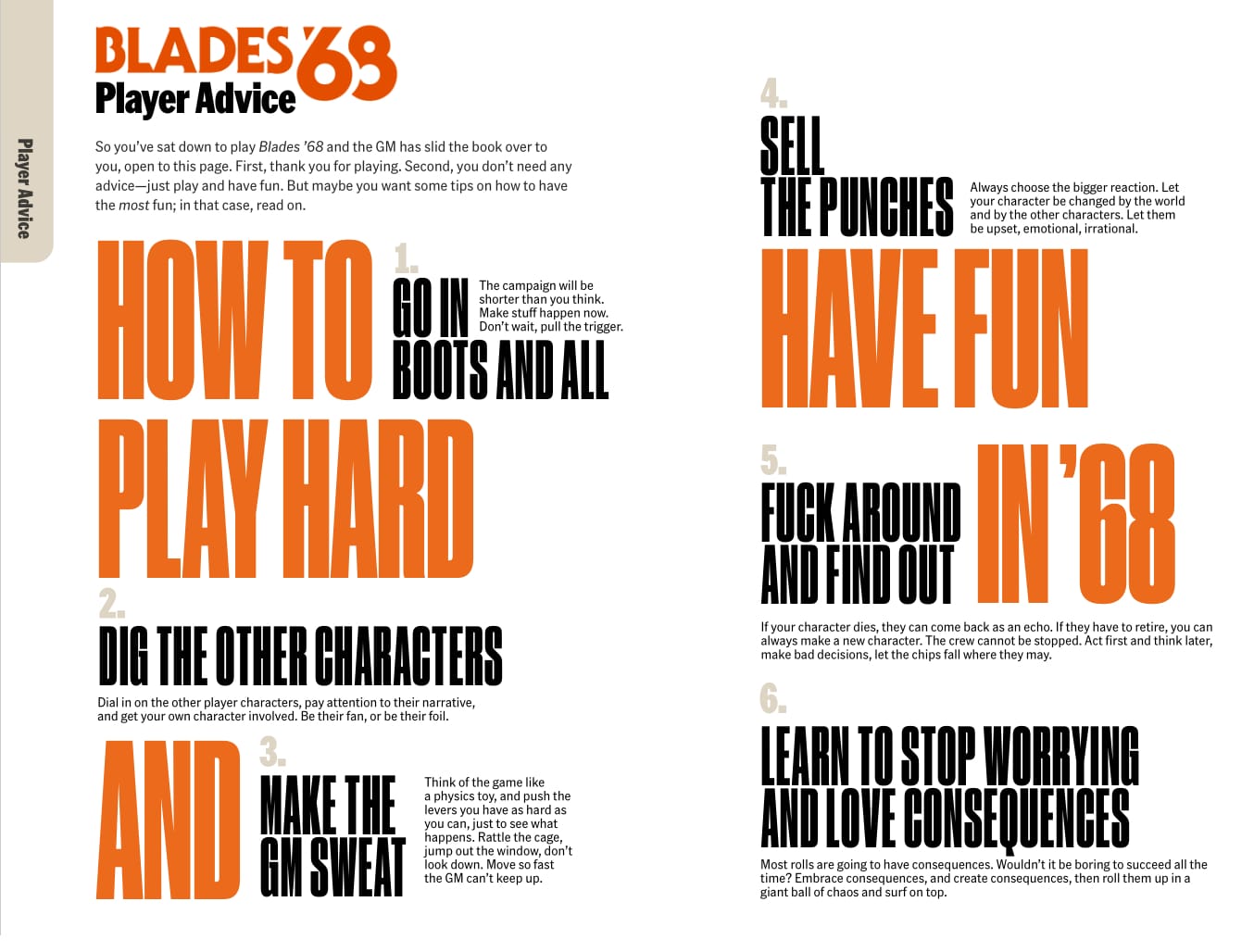
One of my favorite spreads in the game is on page 254-5. It’s a player manifesto, titled “how to play hard and have fun” and gives players six ways to interact with the game, each other, and the Handler. Go in, boots and all; dig the other characters; make the GM sweat; sell the punches; fuck around and find out; and last learn to stop worrying and love the consequences. To be clear, this is great advice, but it would not work nearly as well for the table if it hadn’t been for the rules changes to the characters. With every tweak made, Denee has created a game that has responded not just to the new Doskvol of the Blades 68 setting, but to the new indie play culture, creating a refined and updated sequel that encourages character ownership and development, even as the worst people in the world try try to control you. Or at least, the worst people in Doskvol, which is basically the same thing.