Looters reframes treasure and dungeon crawling as class conflict
Mordite Press’s newest game is more than just an anti–D&D.


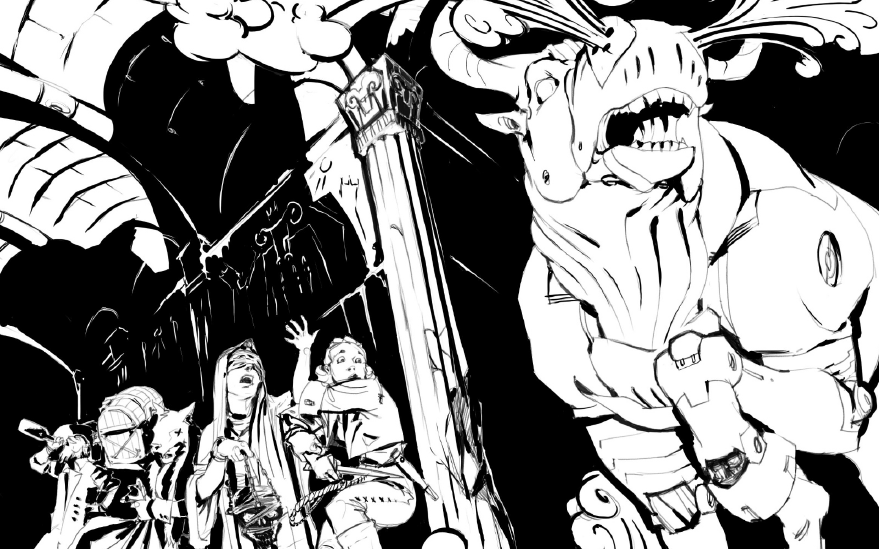
Physical gestures are a crucial component of playing Mordite Press’ Looters, an RPG about roving bands of outcasts looting dungeons. Want to drink a potion? Cast a spell? Pick up loot? You need hands for these. This quirk has led to some humorous scenes during playtesting with friends, as Mordite Press founder Owen O’Connell and designer Duamn Figueroa recalled. One of them was trying to keep a congregation of alligators at bay with a magic entanglement spell, while others were trying to make off with as much loot as possible. “It was mechanically relevant that the guy who's wildly gesticulating made that magic happen. He can't lift a finger to help make off with the loot,” said O’Connell to Rascal. “There was a lot of in-character shouting back and forth about what we should grab. The wizard who's holding everything off wants us to grab a bunch of magic wands, but the guy who's actually in there wants to grab all the magic swords.”
O’Connell pointed out that this sort of interaction tends to show up in almost every session they’ve playtested, which Figueroa attributed to O’Connell’s sense for “humane design.” What this entails is designing a game around the natural behavior of tabletop players, such as losing track of the contents of their inventory. “[These] respond to the idea that this is a game being played by real people at a real table. That's strangely not as common, I have found, in many games,” Figueroa said to Rascal. “We know that people will forget, or mishandle the rules, so why don't we make rules that call out for that and work with that?”
Addressing innate, human centric gaps is one pillar of Looters’ design, but it’s more than just structural. The game also stems from a shared desire between O’Connell and Figueroa to critically examine Dungeons & Dragons (D&D). But O’Connell clarified that Looters isn’t about redoing — or fixing — the issues within D&D’s fantasy setting; it’s about creating a game that allows players to roleplay as flawed characters. “We're coming from a perspective of like, well, what if you don't [fix D&D]? And what if you just treat [the setting] like the real world that we are in, [which is] busted?” he said.
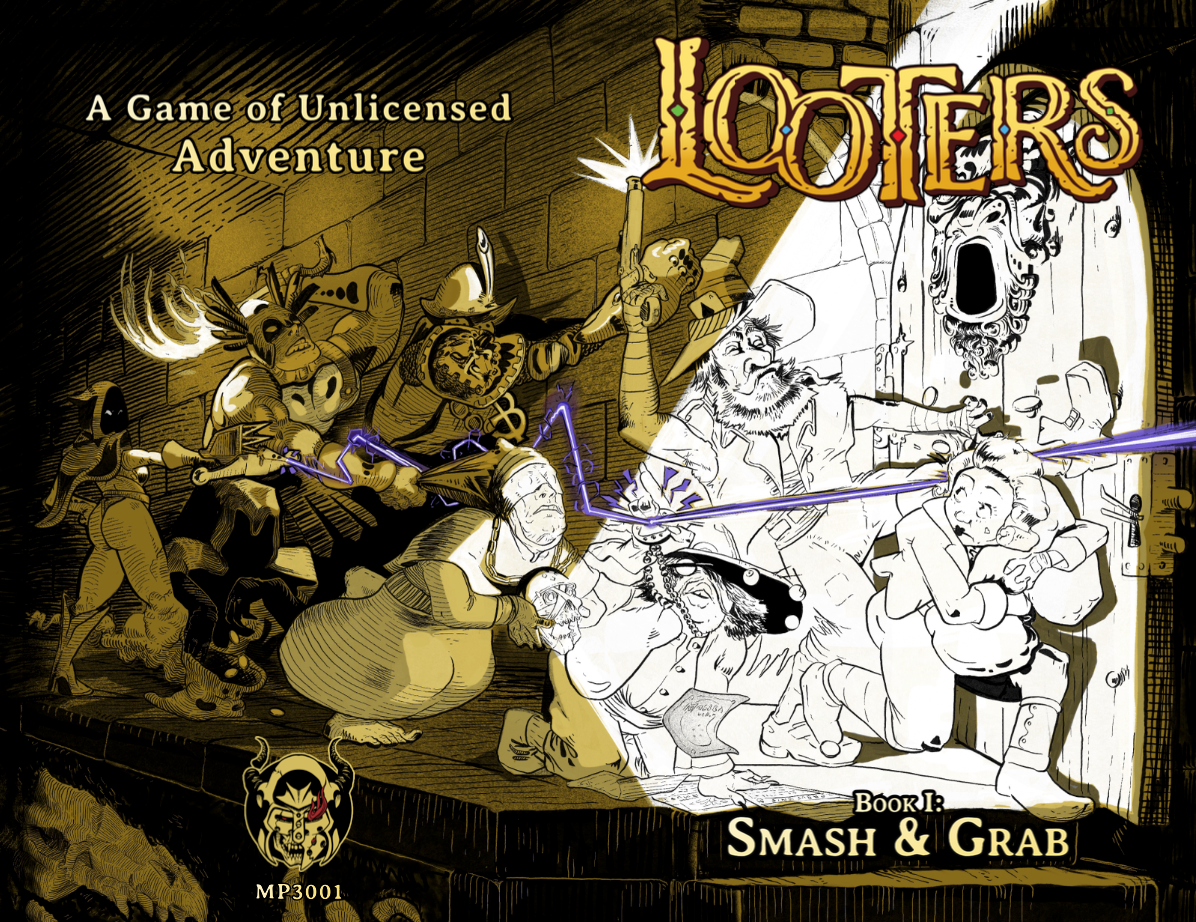
O’Connell was looking to commission art for his Torchbearer blog in 2017 and met Figueroa via the now-defunct Google+ platform. They eventually bonded over their similar criticisms around D&D, though both designers seemed reluctant to characterize this past sentiment as too heavy-handed. Figueroa was quick to point out that these opinions aren’t specific to any edition, given that he played a newer edition of D&D during the 2000s, and O’Connell began his D&D journey when he was much younger, with his experience stemming from an older edition of the game. “We have very strong opinions about the same game that come from different eras and from different outgrowths,” said Figueroa. O’Connell’s brothers, Declan and Paul O’Connell, also joined Mordite Press during the course of Looters’ development, as well as concept artist Matt Gibeault.
But what sparked off ideas for the game that would eventually become Looters was The Grind Turn 3: Hell or Highwater, one of several Torchbearer supplements that Figueroa illustrated. Looters began to take shape when he and O’Connell realized that their favorite aspect of Torchbearer was the notion that characters in the game were not necessarily heroes; the goal is to just survive, whether that’s stealing coins or rubbing shoulders with the disreputable thieves guild. This led to conversations about defining the playable characters of Looters by their criminal charges. To this end, they become looters: adventurers who are branded as thieves, witches, brigands, or heretics for raiding the dungeons without the explicit permission of the king.
“I was part of that full process [of designing Hell or Highwater], so I read it, [and] we play-tested it. I was part of the development, I did some art, and we had a lot of conversations regarding what adventuring is, what fantasy is, and especially [...] what urban fantasy is,” said Figueroa. “We were talking about Fritz Leiber, Fafhrd and the Gray Mouser, about Terry Pratchett. And because of that, we were able to have conversations in Highwater that informed and were in conversation with Looters.”
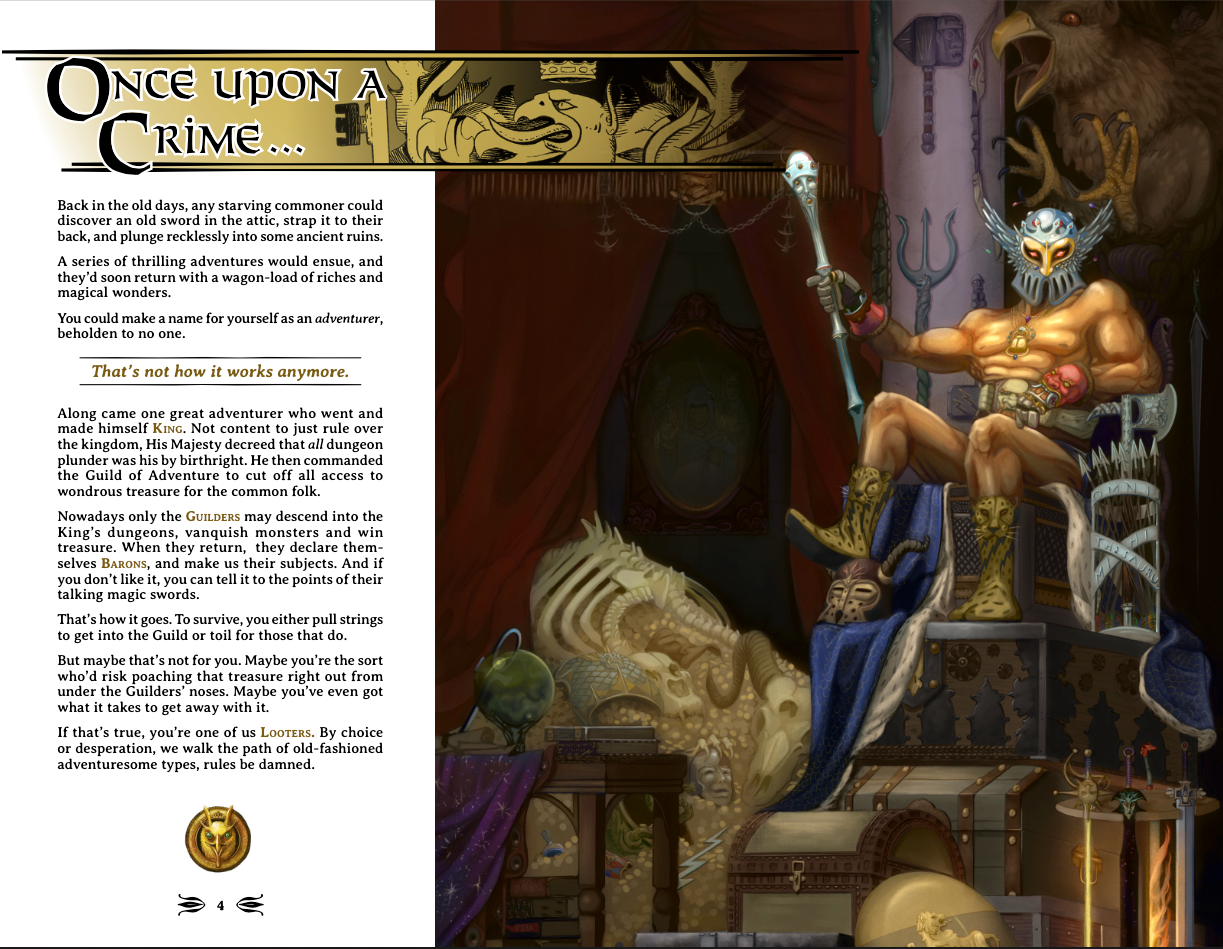
Rather than the unfettered access to treasure and gold typical of D&D, where you can hoard as much treasure as your pockets and inventory can hold, Looters turns this aspect of adventuring on its head. For one, loot is no longer the claim of whoever gathers it; the King has, after all, decreed that dungeon plundering was his birthright, and that no one else aside from guilders can claim the treasures within these ruins. “Straight power fantasy says the world is there for you, to be taken by you,” said O’Connell. “[But] when you play a picaresque version of D&D, it's like nope, the world is not there for you. You get nothing. That's an incitement, almost. Our goal with Looters is to turn that knob up even further, and say well, what do all of these parts of a traditional dungeon crawling setting actually mean [through this lens]?”
Looters’ anti-colonialist themes are also inspired by the designers’ cultural background, with O’Connell based in Ireland and Figueroa living in Argentina. O’Connell said that Irish folklore is centered around folk music ballads about Irish outlaws, such as Brennan on the Moor or The Wild Colonial Boy, whereas Figueroa said that he drew from his cultural background, having learned about colonial Argentina and living through her post-colonial era. At the same time, these have inspired their discussions around what’s missing in D&D’s fantasy setting, where the crevices caused by social inequality are, at best, implied. “There has to be a society around it that will create bandits and cultists and all that,” said Figueroa.
Looters began to take shape when he and O’Connell realized that their favorite aspect of Torchbearer was the notion that characters in the game were not necessarily heroes.
This nuance is perhaps best exemplified in Looters’ Adventurers’ Guild, which Figueroa believed carry parallels to the oppression of migrant workers in real life. The guilders are the only ones permitted to pillage from the dungeons, and everyone else either has to pull strings to join the Guild, or work for them as their subjects. It’s also a perspective that Figueroa is familiar with. “Going into another country and trying to have some economical future there, and finding many walls of bureaucracy and control and finding themselves being a second-class citizen, which I have many stories of because my family and friends have had those experiences, tried to make it in the US [and Europe], and then were bounced back,” he said. At the end of each raid, guilders (or even a rival looting operation) tend to show up to confiscate the treasure you’ve been hauling — and you only get one shot to escape the vicinity before you lose your loot, or worse. Your band of adventurers will need to make a forced retreat, a mechanic that subverts a typical dungeon crawling routine: to the Guild, the looters are more akin to monsters than fellow adventurers, another obstacle to be summarily removed on their path to the loot.
The hierarchy of the adventurers in Looters’ is clear; both guilders and looters are pillaging from the same ruins, yet the looters’ actions are sanctioned, illegal. On the other hand, the actions of the guilders can be seen as righteous, even heroic. Figueroa brought up an example of two groups of people in D&D who are similarly perceived in distinct ways: bandits and rogues. He pointed out that there’s no mechanical difference between the two groups — both steal, sneak around, and are very nimble —- but players don’t typically kill rogues; they kill bandits instead. The difference between the two, then, boils down to classism. “[It’s] the idea that if we have this class issue, and bandits and cultists and all that are killed the same way that monsters are,” said Figueroa. “Maybe that separation is way more blurry than it should be, and a looter has way more in common with, say, an owlbear, or an ogre, than it does with a guilder.”
These are the kind of stories that are unlikely to be told at a D&D table, which is why O’Connell and Figueroa want Looters to be a game that will reflect the social dynamics of our real world. “We wanted to make a game that would give us a way to work through our love-hate relationship with the older RPGs without trying to correct or sanitize it, which I think is all too common in mainstream RPGs right now,” said O’Connell. “I guess Duamn and I are both the kind of people who just feel more comfortable [playing] in a world that [...] resembles our world in that way, by talking about how the things that are wrong with early RPGs are the same things that are wrong with our current world. That lets us play and have fun, talking about things as they really are.”
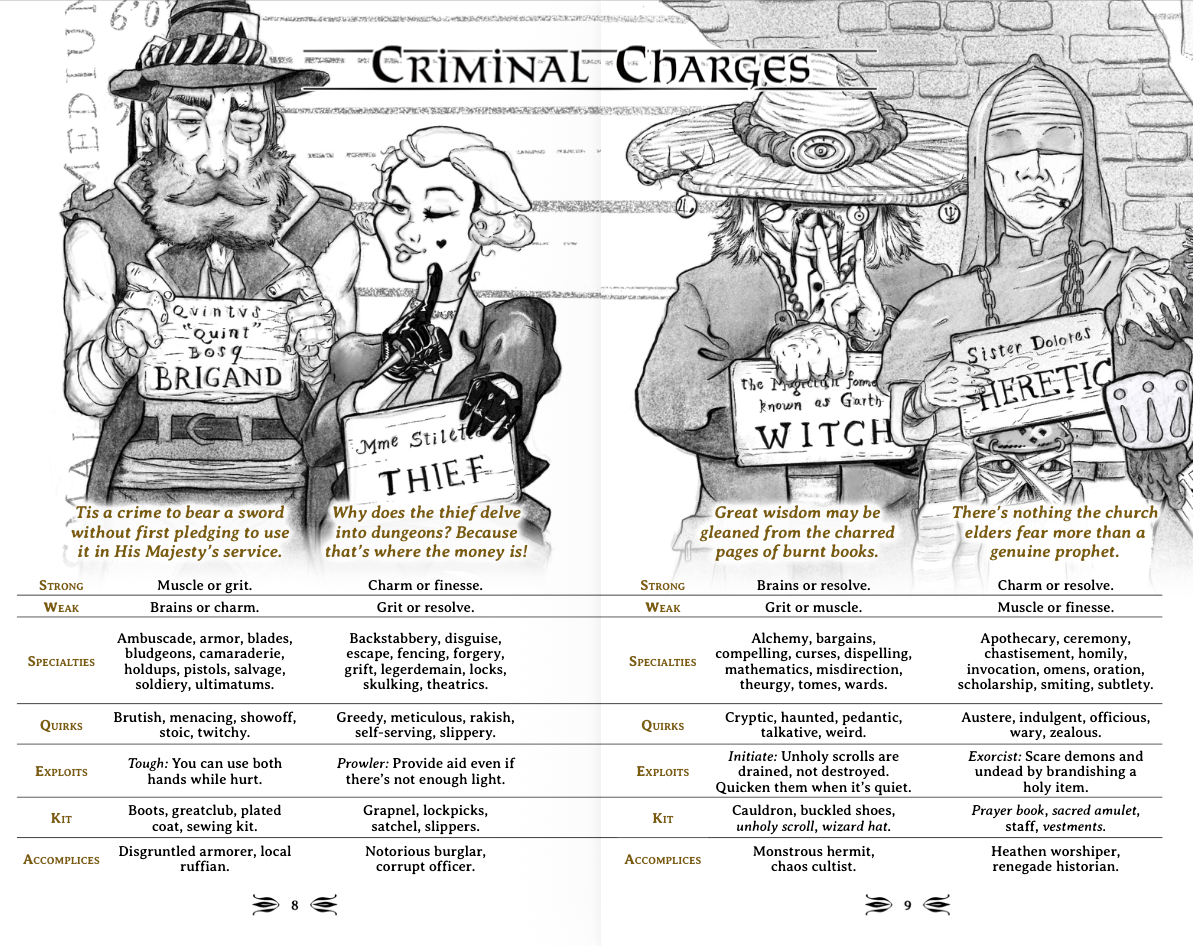
O’Connell also believed that this structure can help players experience other RPGs, including custom dungeons or one-pagers, from a different perspective, as Looters can be implemented into existing adventure supplements. “The ideal mode of the game for me is to take an old adventure module that maybe has some problems in it, that you might not otherwise run, and see it [...] from the perspective of the monsters to some extent,” he said. “I think that the shift in perspective makes it a really liberating and enlightening experience.”
Even though it’s not explicitly about classism, Looters is still designed to create emergent narratives that signal at the underlying inequality at the core of its system. But sessions are rarely dour. O’Connell saw some humor in depicting oppressors, for instance, because many of them can seem like “literal caricatures,” like the real-life royal proclamations penned by King Charles I. At the same time, Figueroa believes comedy acts as a way to relieve stress or tension, an ingredient that would be crucial to introducing levity to Looters. “It was kinda necessary to have that valve be released because otherwise it becomes a misery simulator, which I don't think is the goal for Looters,” he said. “So, of course, we are going to be cracking jokes in it.”
Looters’ anti-colonialist themes are also inspired by the designers’ cultural background, with O’Connell based in Ireland and Figueroa living in Argentina.
This intention manifests in how Looters offers players several ways to resolve conflicts aside from either combat or fleeing; you can negotiate or trick your opponents, too. Figueroa described this system as one that gives way to intermediate stages that result in great stories, as opposed to D&D where you either kill or get killed. Players could, for instance, appeal to a dragon’s megalomania and beg for mercy. That can be why it feels more akin to a heist game rather than a dungeon crawler, due to the way players are interacting and making decisions within its system. “It’s about dungeon crawling not from the perspective of getting inside and just murdering everything, and then grabbing everything that is not nailed to the wall, but rather engaging with the space, exploring it, making decisions about risk and reward, saying okay, we need the money because we are an impoverished class of looter,” said Figueroa. “We know that we have little time. We have to navigate, not defeat, all these challenges and get out as quickly as we can.”
As such, Looters lends itself naturally to honest and genuine play anecdotes. Looters sessions aren’t necessarily about the exploits of heroic adventurers, but about surviving another day in a shitty world — a world that casts people on the periphery as monsters for desperately seizing at opportunity. “In a game that's about picking up treasure and making off with it before asymmetrically powerful monsters show up and drive you off [...] it's always this frantic scramble to grab the treasure that's there and get away,” said O’Connell. “We've had people not able to help with the escape roll, because they were busy prying gold teeth out of a skull that was on the wall.”