Losing everything in HOME - Mech x Kaiju is better with friends
This mapmaking RPG revealed that I am not drift compatible with myself.


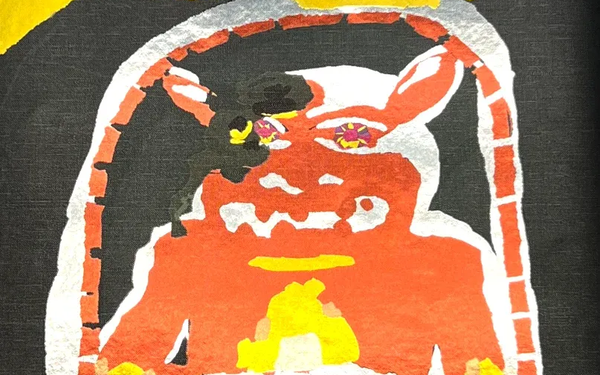
The first pilot’s death sold me on Home - Mech x Kaiju. Marwa and her mech were lost when the monstrous Jotun, its body composed of a teeming swarm of smaller nightmares, rent VOYAGER’s frame apart. Marwa detonated its core at the last moment, ensuring mutual destruction. An electric blue star shone from the mountain peaks west of her home city of Kawatha, and then winked out.
The second pilot failed to stop the incursion of the next two kaiju. Their story, no less dramatic for emerging alive but traumatized, revealed that Home needs other players to really work. The fact that this collaborative mapmaking RPG balances on a single trick isn’t a problem — plenty of games make hay out of tight loops and sparse mechanics. Instead, performing that trick three times all by myself felt formulaic, even pat. Home concerns itself with stories of intense, singular combat with massive stakes, which need someone else driving the point of the metaphorical sword towards my neck.
Designed by Nick Gralewicz of Deep Dark Games, Home supports up to four players who all portray pilots defending their fictional countries from kaiju that emerge from an otherworldly rift. One-on-one battles between mechs and the rampaging terrors encompass the majority of Home’s mechanics; the rest comprises question-based prompts that create room to humanize the pilot and connect them with other people, cultures, memories, and emotions.
Reading this article only requires an email!
But if you want to become a paid member, we're currently running a 2nd anniversary discount - 20% off the first six months.
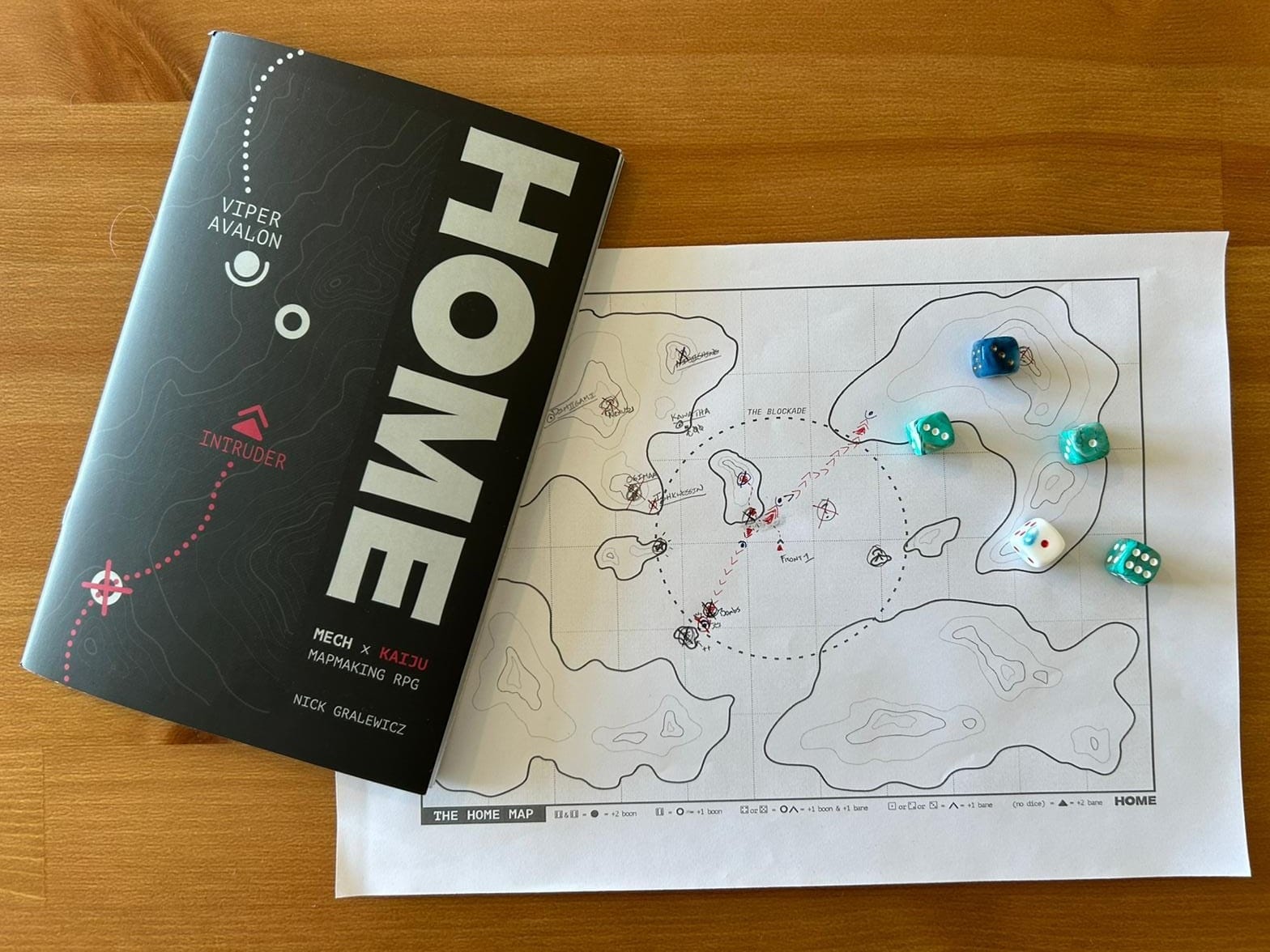
If you play solo (as I did), then you must control both the pilots and the kaiju in three battles that take place across several years. Triumph temporarily drives the alien creatures back into the rift; failure allows them to rampage through towns, vital resources, and whole nations before either the military atomizes them with nuclear payloads or the kaiju voluntarily returns home, satiated by humanity’s abject defeat. Playing as a group allows other members to take control of the kaiju, not only revealing their composition and abilities in cinematic fashion but also rolling opposing dice during battle. It is much more satisfying and tense as opposed to the goldfishing nature of solo play.
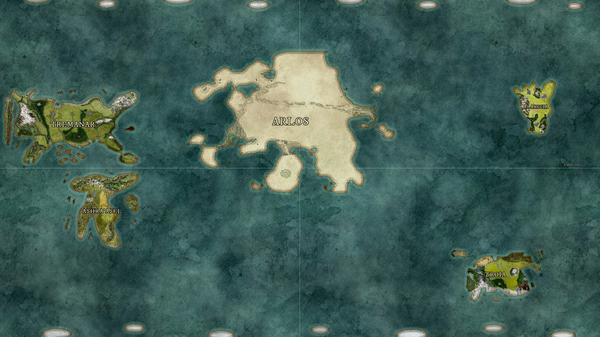
Home resolves the collision between titanic forces with a dice pool of beneficial and detrimental dice, called Boons and Banes, respectively. Players earn Boon dice by making three Preparation Moves during each of the game’s three Fronts — the tenuous barrier between our world and that of the kaiju. The six possible moves (holding a rally, building an armory, studying the kaiju, etc.) prompts a descriptive scene and the opportunity to draw on the map, adding strategic locations among the capital cities, religious sites, and graveyards of past battles.
Rolling well — at least a four on a d6 — adds Boons to the final showdown of the Front. Misses add Banes, which will cancel out Boon dice with matching values. It’s a neat distillation of the idea that no amount of preparation, training, and foresight can account for luck. Every battle holds the chance for failure, perhaps even dramatic defeat at a pivotal moment. Some players might balk at such loose probability arrays when watching their well-laid plans eviscerated by an errant six on a Bane die. But Home isn’t about winning; it’s about mustering the courage to protect what matters, and salvaging that courage to carry on through the wreckage.
Home’s setting is seeded through random tables that players will work through at the beginning of the game, drawn both from the mech’s playbook and its pilot. Characters become prisms through which the player’s creativity can fragment into colors and context. What is their homeland known for? What connection springs to mind when the pilot prepares for danger? Even the mech’s array of offensive and auxiliary weapons amount to flavor and what you call to mind when controlling the narrative’s camera.
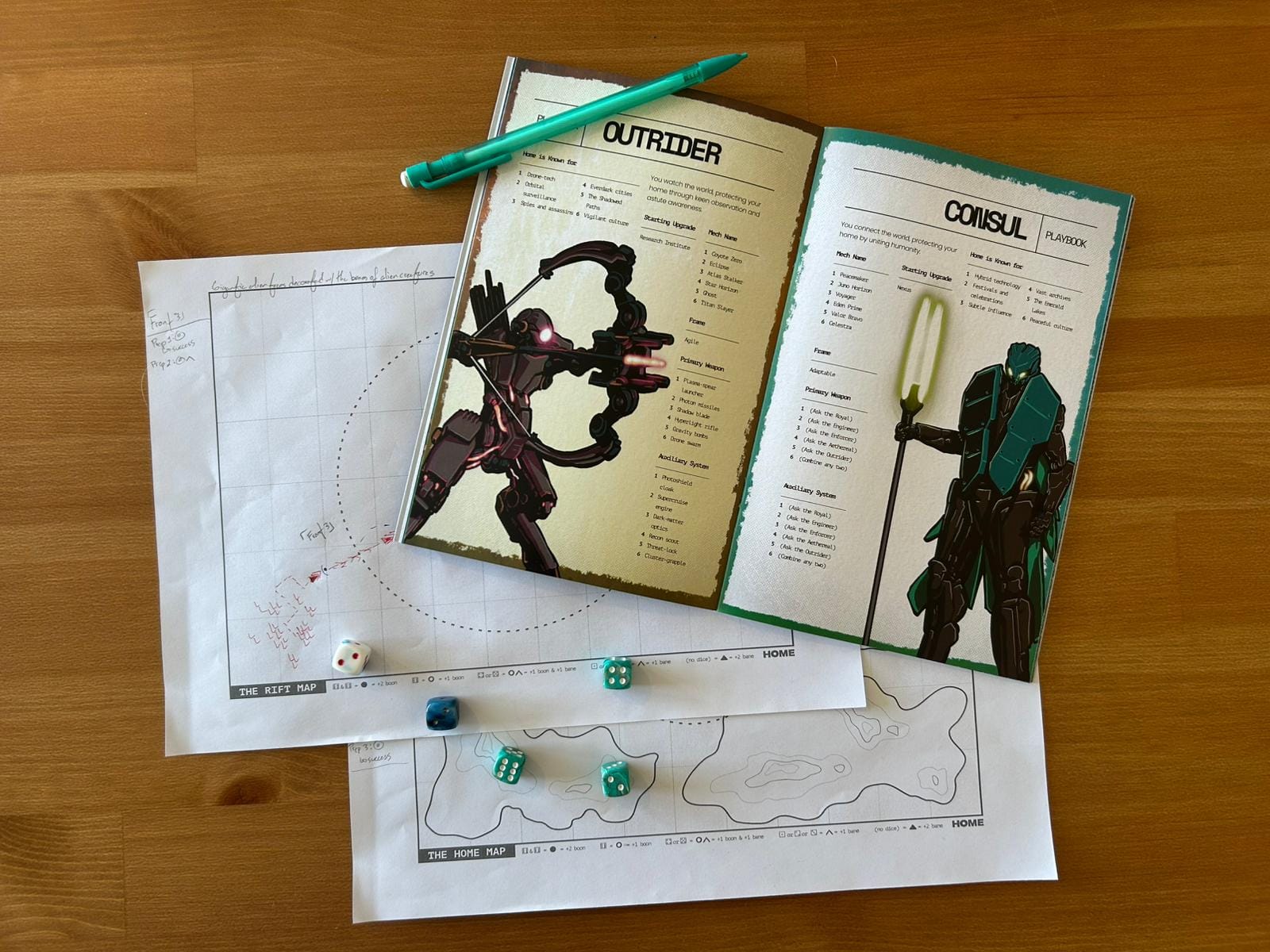
Gralewicz calls these prompts “embracing your connection.” Players could roleplay a scene between their pilot and another character, but Home frames answering the prompts the same way a WWII bomber pilot would grasp a sun-bleached photograph wedged into the console of their aircraft — brief, potent memories bubbling to the surface. A flashback, in the parlance of television. They exist only to lend the fight against each kaiju stakes, but that is the whole point of this game. Losing one troop on a board is logistics. Losing VIPER AVALON, and thus the last connection to a dead mechanic-turned-friend? That’s a tragedy.
As a mapmaking game, Home could offer more interaction beyond noting critical sites on the included map, which portrays an archipelago of massive islands. After one thorough playthrough, I wished the game would focus down on the regional level and trade the destruction of whole metropolitan areas for the razing of farms, towns, and temples, a la Battletech’s video game outings. You could still sell the awesome power of both mechs and the kaiju, but the cultural and infrastructural collateral could be felt in the way one Front changes over the years. Old battlegrounds become scars. The blown out wreckage of homes a passing curiosity as the next beast thunders towards a critical aquifer.
Bring at least one friend into Home’s storytelling arena, as that’s where its collection of mechanics and prompts really shine. Bounce ideas off one another and relish the chance to embody a ravenous, horrific force of devastation. Such contrast might even hone your own losses to a keener edge as your friend delights in rolling two sixes on the Bane dice and dismantling your final stand. Heroism, or tragedy, is sweeter when shared.