Monte Cook on dungeon design, Gygaxian feedback, and shaping the $5 PDF
And why he didn't stay on the design team for D&D 5e.

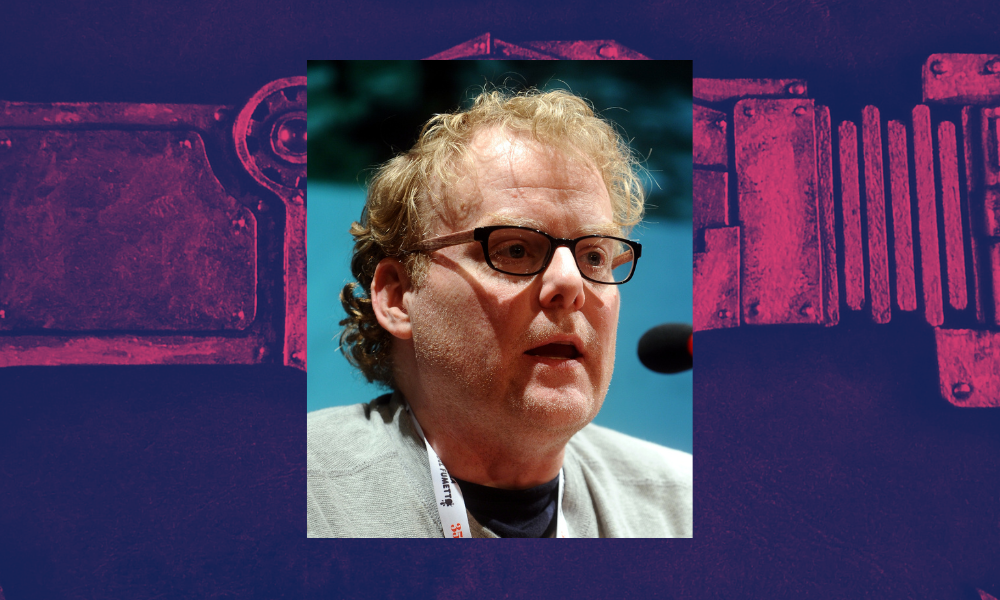
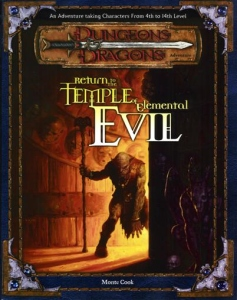
Monte Cook is one of the most recognizable names in RPG design today with a career almost at the 40-year mark. Over that time, he’s worked on Rolemaster, Champions, and of course, Dungeons & Dragons, co-designing the third edition. He wrote that edition’s Dungeon Master’s Guide as well as the sequel adventure Return to the Temple of Elemental Evil. But since then, there’s been very few dungeons or dragons in his work.
Monte Cook Games have only published a little bit of classic fantasy over the last decade (including re-releasing a new edition of Ptolus, subtitled “Monte Cook’s City by the Spire”). But mostly, they choose to walk a different path. Numenera and Invisible Sun, for example, are both fantasy worlds but built from the ground up to be a little bit bendy when it comes to genre.
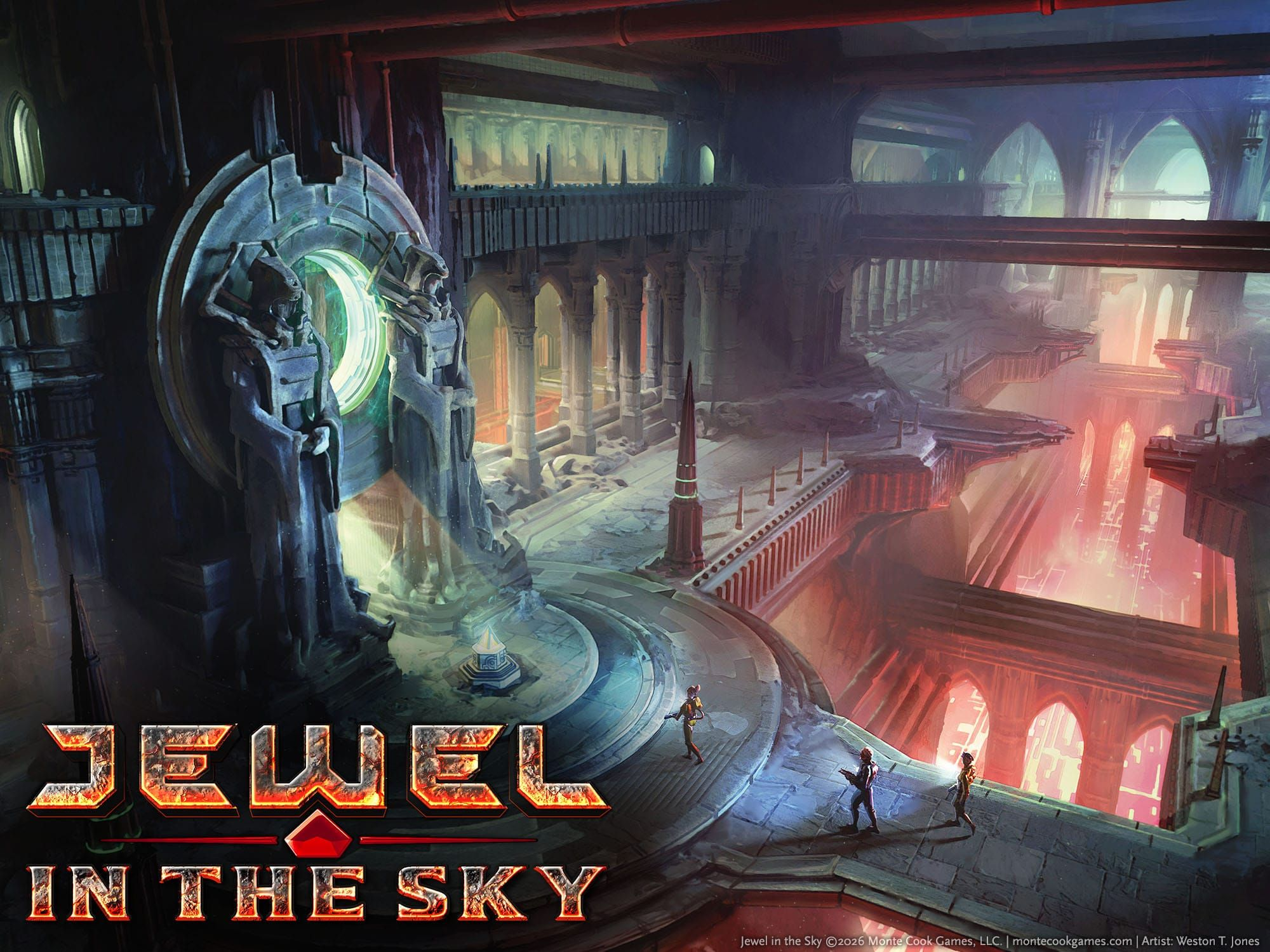
That trend continues in Cook’s 2026 return to the dungeon format. Jewel in the Sky, which is crowdfunding as a part of Backerkit’s Megadungeon Month, has a cool trick at the center. Inspired by the classic D&D module Expedition to the Barrier Peaks, it’s either a fantasy adventure with a sci-fi twist or a sci-fi adventure set in a strange fantasy world.
Rascal sat down with Monte Cook to talk about his illustrious career, leaving Wizards of the Coast (twice), and what excites him about game design so many decades later.
This interview has been edited for length and clarity.
Thomas Manuel: Can you tell me a little bit about what it was like working in the RPG industry in the ‘90s?
Monte Cook: It was so different. I can just say it in one word, and that's the internet. The internet changed everything. When I got started in the industry, I worked at this little company, not even around anymore, called Iron Crown Enterprises. And the only contact that we had with gamers was either at conventions, or we would put these little forms in the backs of our books that people could photocopy and answer these questions. It was so skewed, because, of course, who's gonna do that? Who's gonna photocopy a page out of their book, and fill this in and pay for the stamp to send it to it, right? Mostly, it was people with a bone to pick.
Manuel: Over the ‘90s, your reputation was developing, you were getting credit for being one of the leading game designers in the field. Was there a specific moment when your name became recognizable?
Cook: It grew slowly, and then 3rd Edition D&D came out, and that changed everything, right? It turned the volume up to 11. I remember the moment where someone was introducing me to a friend of theirs and they said, this is Monte Cook. And the person's reply was, THE Monte Cook? That was a very weird moment. I'm not really comfortable with that kind of exposure. I'm actually a very private, introverted person.
Manuel: There's a quote, on your Wikipedia page, where Gary Gygax says that the 3rd edition DMG would make him a better Dungeon Master. How did that happen?
Cook: When we had the manuscripts for all three of the main 3rd edition books, we sent them to Gary, and I had known Gary a little bit before then. But not very much. And for the rest of my life, I will remember getting back this long letter from him that was talking about all the great things in the Player's Handbook, and then he wrote, oh, but the DMG, that is a work of art. As a person who got started playing these games… when I was a little kid, I used my friend's books, so the first thing that I owned was the Dungeon Master's Guide that Gary wrote, so it very much felt like a full circle, thrilling moment to hear that from him. As time went on, Gary had less positive things to say about 3rd edition, but I don't care. I'm gonna ignore that.
Manuel: So, 3rd Edition comes out, and that's the first edition that has a digital presence. You were one of the first people to have success with digital publishing, i.e., PDFs, What was that change like?
Cook: I think Wizards had experimented with making some PDF products, but they didn't have very much success, because people wanted the books. But when I left Wizards of the Coast in 2001, I wanted to do some of my own stuff, and I had no idea how to make a book. How do I work with a printer? Where do I warehouse? I'd just been a designer my whole career, not done any of those practical level things. A lot of people now talk about that as a very innovative, groundbreaking thing, but I looked at it as a dodge. I didn't want to do all this stuff that seems hard, so this digital seems easier.
There were only, like, two or maybe three different platforms on the internet where someone could make a digital file of anything. and sell it to people, and charge money for it. And so I found this place that actually was designed for people who made really limited programs — if they wanted to make updates or patches, they would go through that — and I had no idea if it was gonna be successful. I was pessimistic: How would people even know [the link]? Why would they do that?
And it turned out to be wildly successful. It's funny sometimes, when I look back — in those days, every PDF cost $5, and that was because the first PDF that I did cost $5. And that was because that was the lowest amount that [the site] would allow you to charge. If it was lower than that, it wasn't worth their time. It's like the thing where train tracks are the width that they are, supposedly, because that was the standardized width of a wagon, right? I find that very fascinating, and so it makes me smile when I think about $5 PDFs.
Manuel: Just water taking the shape of the bottle...
Cook: Exactly, that is exactly right.
Manuel: Can you give me a sense of what you mean by success? What’s a lot of PDFs to move back then?
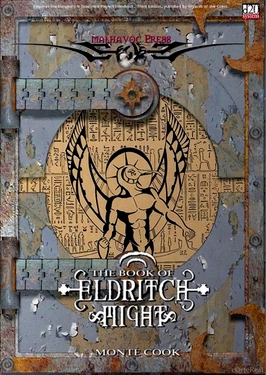
Cook: In that particular case, I remember asking my friend Bruce, do you think I'll sell 50 of these? 100? If I can do 100, I think it's worth doing. But we sold a thousand on the first day, right? That book was called The Book of Eldritch Might, and I still sell a few copies now and again. It was like 30 to 40,000 copies. It's fascinating to me that in those — what I think of as those heady days of D20 and 3rd edition D&D — those of us who were lucky enough to get in and make a name for ourselves, we were selling really big numbers. Not Wizards of the Coast numbers, but by today's standards? Really big numbers. It was exciting to be a part of that, and kind of overwhelming.
Manuel: So you go out and start your own studio, Malhavoc Press.
Cook: It's literally my first D&D character's name. My 14-year-old [self]’s first character.
Manuel: Oh yeah, it does have that edge to it. Was your own press about owning your work going forward?
Cook: That was a huge part of it. But there was a moment — one of those things where I can look back, and I can see the precise moment — I was still working at Wizards. I was in the office of my manager, and I looked over on his desk, and I said, what's that? And he said, oh, that's the finished manuscript for Return to the Temple of Elemental Evil — which I had written.
And there was a piece of paper clipped to the front of it. And on this piece of paper, there were 17 different names with check marks. And I said, who are all these people? And he said, these are the people who have to check off to approve that this thing gets made. That's just absurd to me. There's too many cooks in the kitchen. That's not a way to view creative enterprise, in my opinion. That was the moment.
Manuel: What can you tell me about that moment when you were asked back to come back to work on D&D 5E? I know that didn't work out, and you left, and you started your own thing again. The cycle repeats. So, what happened there?
Cook: Basically a lot of promises were made to me that didn't pan out. They weren't really promises in terms of salary or anything like that, but they were promises that were like, here's what we're gonna do with D&D, we're gonna embrace the creativity, and we're gonna go back to making very friendly, low-budget adventure modules, and all these things that I thought would be really good for the audience and for the game. I sort of feel like the game lost its way probably around the time of 3.5, and then into 4th Edition — there were just a lot of things that I took umbrage with. But none of those [promises] were coming true, and they clearly weren't going to come true.
And this was a weird time because this was before Critical Role. So, Wizards had not seen the huge, dramatic success that Critical Role would help bring about with 5th Edition. And so, there was a decent chance that this was just gonna be the last edition, and we were just gonna do some core books, and then sell the license to video game companies, and that was gonna be the end of Dungeons & Dragons. Obviously that didn't happen, and thank goodness it didn't happen. But it just stopped being something that I wanted to be a part of. It had nothing to do with the creative end of things. But I think I burned bridges more than I realized that I did.
Manuel: Yeah, I can believe if that number was 17 people in 2001, then it would have been 170 people by 2011.
Cook: The corporate culture had become way more corporate. I have very strong feelings about how creative material of any kind should be produced, and I think a big corporation is the worst way to do it. I think that creative people should be allowed to work in whatever way works best for them. So, if you're the kind of person who gets X number of words written every day, that's great. If you're the kind of person who saves it all ‘til the end and pulls a bunch of all-nighters, but it's still really good, I don't care.
A lot of this is a reaction to things that I've encountered in my life. When I worked at TSR, I had to be there at 9 and couldn't leave until 5, and people watched the clock like you see in movies. That's no way to do creative work. So, it's just trying to manage people in the way that I wish that I had been managed.
Manuel: So then, how do you balance that with what the market wants?
Cook: I am aware that part of this is probably because it's called Monte Cook Games, right? On some level, the other people at the company are probably not going to tell me what to do too much. And that's got its own problems, but when I have an idea for something that we should do, in terms of a new product, new product line, new crowdfunder, whatever, I feel like it's my job to sell everyone else on that idea. And if I can get Charles [Ryan, COO] excited about it, if I can get Teri [Litorco, Managing Editor] excited about it, then because they're all gamers, I know that I've got a good thing here. I know that they're gonna be happy editing what I'm writing, and marketing what I wrote, and that kind of thing, right? Because they're excited about it, too.
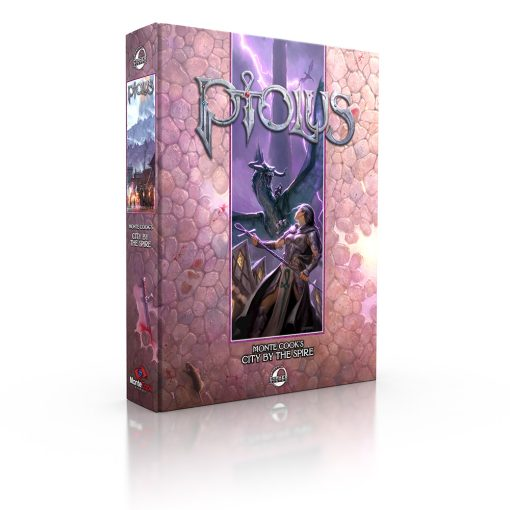
Manuel: How does scale fit into this? I’m thinking of Ptolus, Invisible Sun — the scale of these products is part of the charm. Is that something that excites you? Is that something the market demands?
Cook: Both the products that you mention gained life because they were ideas that I thought were worth making something really big and beautiful and remarkable. Not every idea deserves that, or needs that, and not every idea gets it. But those two in particular — this is sort of the advantage of having your name and the company name — I basically got to make Invisible Sun into exactly the game that I wanted it to be. I'm super proud and happy with it.
I'm a huge gamer. I play a lot of games. I run multiple games every week, all different systems and everything, and I've been doing that for the vast majority of my life, and I'm getting old, so I feel that if something works out well at my game table — and experience has proved this to be the case — I'm fairly confident it’s going to work at some other group's game tables, too. And often more than I even expected. But everything starts out at my game table first and then becomes a product. It's not the other way around, where I think to myself, okay, let's make Invisible Sun, and I guess we better start playtesting it. That doesn't happen.
Manuel: Is that also how Jewel in the Sky began?
Cook: I read a lot of game products, not just ours, but a lot of game products. I currently have a Shadowdark game, and I'm using some adventures that other people have written and everything. Some of the reason for that is just out of necessity, and some of it is because I want to see for myself. Everyone's designing adventures and dungeon adventures and making choices on how to present the material, and I have developed very firm opinions about the best ways to do that. I look back at some big adventure that I wrote 20 years ago, and I just say, what a hassle this would be to run. It's a constantly honing process to the point where the thing that I'm most excited about Jewel in the Sky is actually the boring format of the way the information is presented.
In Jewel in the Sky, every section of the dungeon gets four pages, and the first page will just be background and stuff that is fun to read, but it isn't necessary to have access at the table. And then there's a two-page spread, which has a map, and all the information that you need to run all those encounters and do all that stuff is right there in succinct bullet points. Then, all the game stats are on the fourth page.
I'm running Jewel in the Sky, not surprisingly, for both a fantasy group and a science fiction group. And it's really easy to run. It's really fun. All the information is just right there.Tying things directly to the map, as opposed to [saying], this is room 7 and I have to flip to where the map is to see where room 7 is, none of that. It's all just right there on the map. I'm not trying to be hypercritical of other people's work here because I've done this, too, but if I look in the adventure, and it says Room 7, 500 years ago, blah blah blah, that's just going to slow me down when I'm sitting there at the table trying to find out: what the players actually see, what do they feel, what do they smell?
I'm picking up a lot of stuff that the OSR is doing. I think there are things about OSR gaming that I don't understand — the randomness and all of that. But the clear and concise nature of giving the Game Master the tools, I like very much. A concept that I've been dealing with is the idea that the encounters constellate, right? Which is the word that we use for when the Greeks looked up at the sky and said, oh, that is Archer, right? Really, those stars have nothing to do with each other, they just happen to be in the same place, and someone imagined it.
The encounters in a roleplaying game adventure, they kind of constellate, they're all separate things, but then we, as creative humans, bring them all together, and these stories become very character-focused because that's what is linking all of these encounters together. It is such a uniquely RPG experience. That's why I'm still doing this, right? You can't get that from any other art form.
Manuel: What about the central feature of players choosing between a sci-fi or fantasy campaign? What’s the story behind that?
Cook: Well, it is playable as a science fiction adventure or as a fantasy adventure, and it's all just the direction that you're coming at it from, which is actually based on an idea that I had back in the ‘70s. There was this D&D adventure called Expedition to the Barrier Peaks, where you're fantasy adventurers exploring this crashed spaceship. Even as I played that, I thought, you know what would be cool? If we played science fiction people who were coming to the planet and trying to recover this crap, and having to deal with all these weird fantasy monsters that they don't understand.
Because I like weird and surreal [settings], I’m postulating that the magic and the technology and the science and the radiation and everything have created their own sort of unique third thing, which is just weird. Like there was a huge computer system in this secret base that the people from another planet had put on this fantasy world, and over the years, the magic has interacted with its computer system that it turned it into basically like a river of data. So now there's this river flowing through the middle of the dungeon that is just literally raw information, you can just reach in and learn things. That kind of a thing, creating something that's brand new by taking stuff that — we all know the fantasy cliches, we know the science fiction cliches, oh, there's a robot, oh, there's a guy with a magic sword, none of that is gonna really thrill people too much, right? But using those things and mashing them together to make something new, I think that's exciting. That's where that comes from. My dream is to just blow people's minds every time they sit down at the game table.