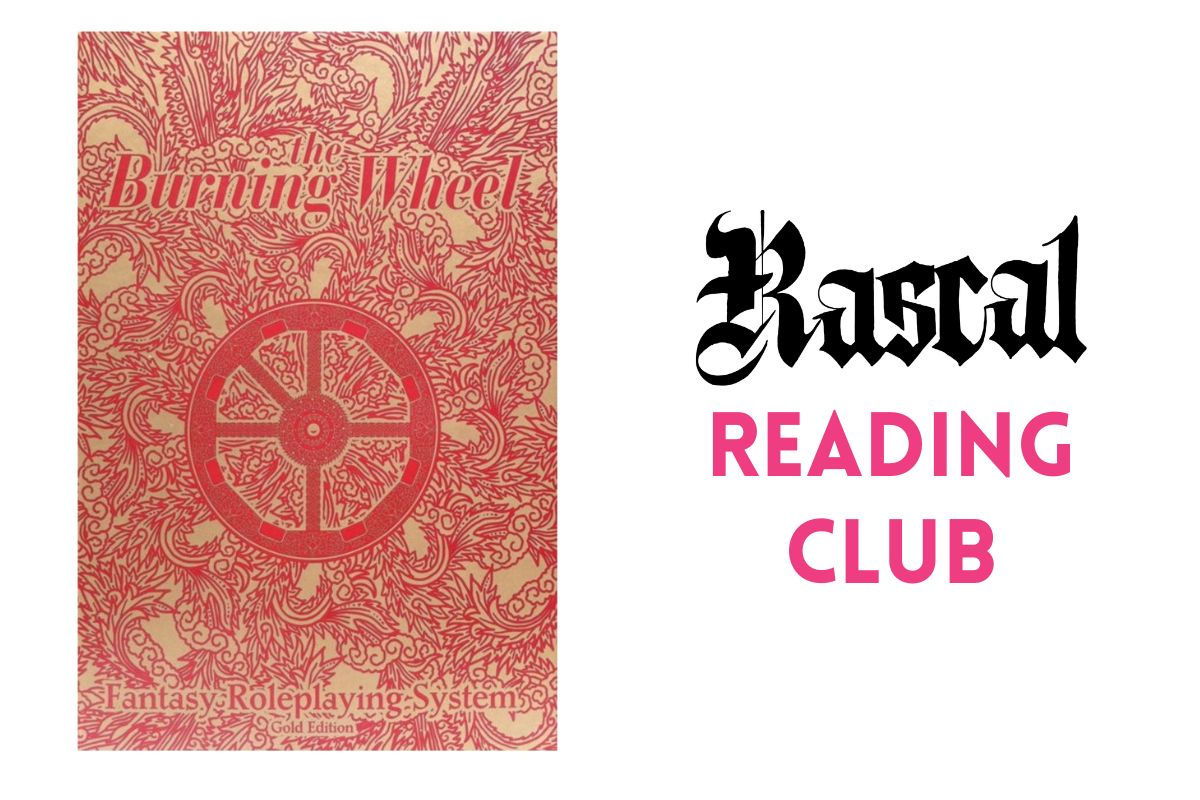
Rascal Reading Club: Burning Wheel
Attack their beliefs.

Listen to the latest episode in your podcast player of choice!
This week, we're discussing Burning Wheel. We're talking about the game's approach to rules and the value of system mastery, how it puts beliefs at the centre for both the players as well as the GM, and we talk about quests, struggles, and intrigues.
Excerpt:
And the idea of a character drama is that you get that drama by challenging the character's beliefs. Say a character has a belief like, "i believe that so-and-so should be the rightful ruler of this kingdom." And then the thing you do as a GM is that you work at, around, and towards that belief.
You can challenge it very explicitly in the sense of here is this person behaving in a way that maybe suggests that they shouldn't be the ruler. Here is a person that maybe could be a better ruler. Here is something that actually suggests, yes, you are right, they should be the ruler. Here is a thing that complicates this idea of there should be a ruler at all. You circle around it, right? You affirm it, you, contradict it, you, you explore that belief in as many ways as you possibly can, and that is the source of the drama.
And that is really good and insightful because a lot of other games, the only tools they give us to do that is a character's hit points. I mean this in the sense of say you are organizing a combat encounter, And the way that you construct that combat encounter in a more tactical game, like Draw Steel, for example, is that you will build something that is a fun tactical challenge. (And again, I should say that Draw Steel actually like has specific advice not to do just this.) So you will construct a challenging encounter, and you will think this is a good encounter because it will rely on the players engaging in system mastery to succeed — the extent that they have to try, that's how you know made a good encounter.
Now, in Burning Wheel, it's only a good encounter — and there is still system mastery, there is that tactical stuff, there is combat, all of that stuff is there. It is a system mastery kind of game. But, the way that you will construct a combat encounter is like, "Hey, how does this combat encounter challenge one or two or all of my players' beliefs?"
This is, again, standard advice. In Draw Steel also, there's the advice that the encounter should be about something. It doesn't really need to be like a, a death match. Like what is the antagonist agenda? What is their success condition? What is your success condition? But thinking about it in that way is advice. In Burning Wheel, everything is laser-focused on beliefs. the players are thinking about their beliefs because that's what starts and ends their gameplay loop, their advancement. It's the big thing at the top of their character sheet. It's very clear that this is what you've been focusing on.
So even as the GM, if you ever do anything that doesn't feel like it engages with their beliefs, that's a sign that maybe either their beliefs are not written in a way that's conducive to you engaging with or that you've made a mistake essentially, right? That you've sort of wandered down the wrong path. You've gotten confused about what's important to do in this game.
As always, you can participate in the discussion! Please respond by June 2nd or 3rd, either by posting in the official discord or writing to thomas@rascal.news and we'll include your responses in the talkback episode.
Participation is open to everyone, including non-subscribers!
Discussion Questions
- What do you think about Burning Wheel?
- What's been your experience with games that ask players to write freeform statements like Beliefs in Burning Wheel or Aspects in Fate? Do you feel like you lose some of that freedom in games that just give you a list to pick from?
- What do you think about the idea of system mastery as a GM? Does it feel different to run games that are about those versus games that don't offer that? Do you have different tastes as a player and as a GM when it comes to games that offer system mastery?
- Do you agree with my statement that it feels like system mastery in the OSR or storygames is about mastering (specific, identifiable) skills that are broadly compatible across similar games?
- What do you think about the classification of quests, struggles, and intrigues? Does that feel useful to you? Do you feel like you're better at some or prefer some over others?
If you're a member of Rascal’s Party Member tier, you can nominate a book and decide what we discuss next in the series.