RPG Trader’s digital storefront wants to be the creator-friendly, RPG-focused alternative
Trading market majority for sustainability.

When it comes to selling games online, discoverability has been a perennial problem. Take DriveThruRPG, the juggernaut of digital storefronts for tabletop games; the several front-page categories into which RPGs get sorted are largely limited and overly broad, such as popular titles, newly published games and product types. And while itch.io is exceedingly popular among indie designers for its high revenue share and other indie-friendly practices, such as customisable product pages, it was originally designed to host video games and provides limited features and categories specifically geared towards tabletop RPGs.
This is why Hugh Lashbrooke has set up RPG Trader, a new digital marketplace with a bowtie-wearing dragon as a mascot. As a designer and founder of Ten Acre Games, Lashbrookhe has encountered the same challenges that many creators face, and wanted to create a new marketplace that can address these issues by emphasizing discoverability, alongside adding features like flexible publishing, integrated print-on-demand, and tools that help creators reach out to more buyers.
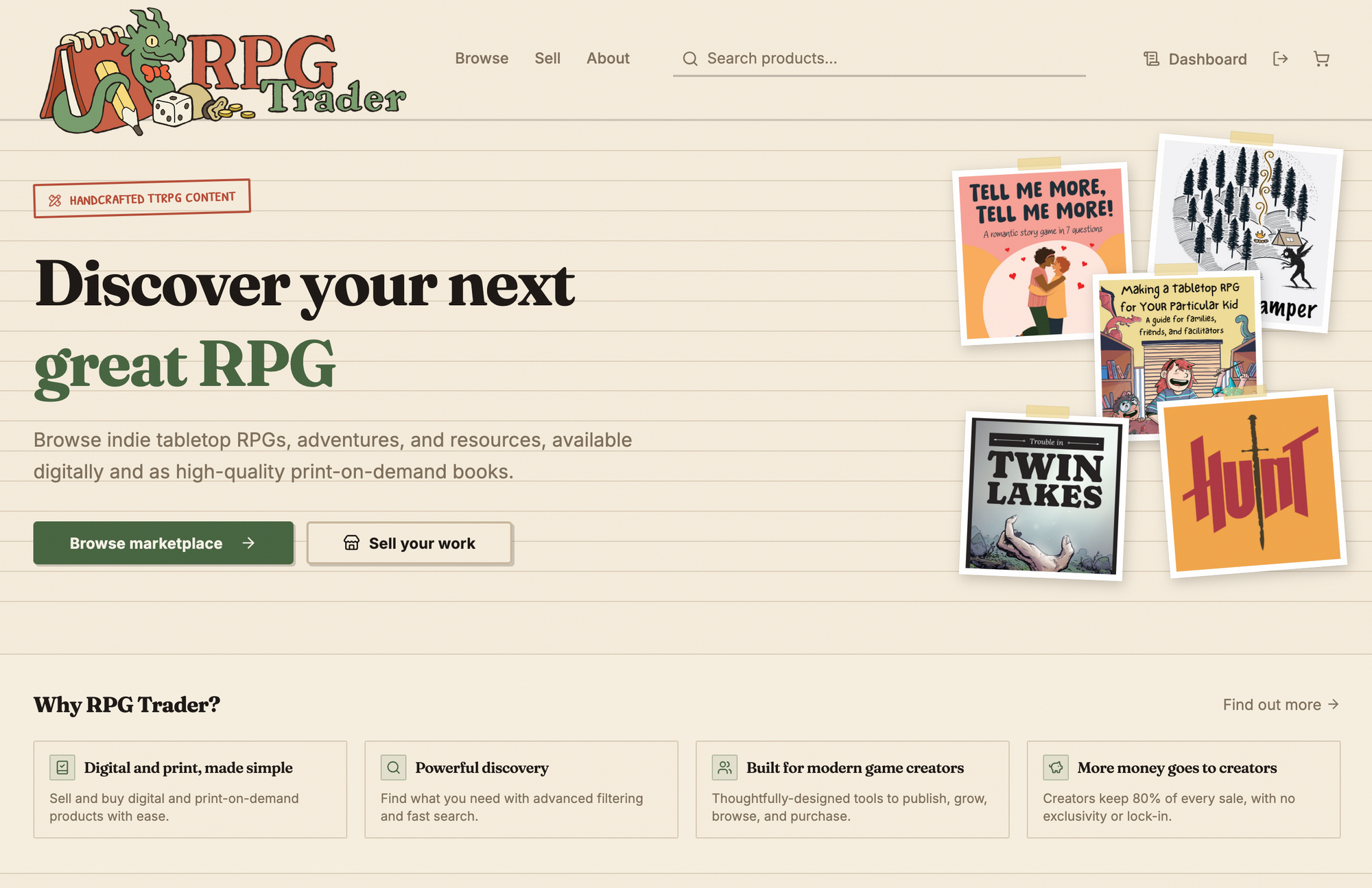
In an email to Rascal, Lashbrooke said that the point isn’t to have RPG Trader replace storefronts such as DriveThruRPG and itch.io. “We obviously have a lot of overlap with existing storefronts, but there’s a lot that distinguishes us as well, and we really want to lean into those things we know we do well,” he said. “Many creators already publish on multiple platforms, and I expect that will continue. RPG Trader isn't asking creators to choose sides. We're just trying to create a place that's valuable enough that they want to be there alongside any platforms they currently use.” The focus is on serving the indie creators market, with Lashbrooke saying in an interview with TTRPG Insider that the site wants to reduce “the friction for people to go from creating a game to having it available for sale.”
One of RPG Trader’s most evident creator-centered feature is the 80 percent payouts from sales — a figure that’s notably higher than DriveThruRPG’s 65 to 70 percent rate, but still lower than itch.io’s maximum rate of 100 percent (although this is set to 90 percent by default and can be adjusted by customers). In addition to overarching categories such as adventure modules, campaign settings, and art assets, RPG Trader also included tags that let players find RPGs specific to their preferences: play style, settings, and even tonality. It’s a system that seems attuned for discovering indie RPGs beyond the seismic hits of Dungeons & Dragons, Pathfinder and World of Darkness.
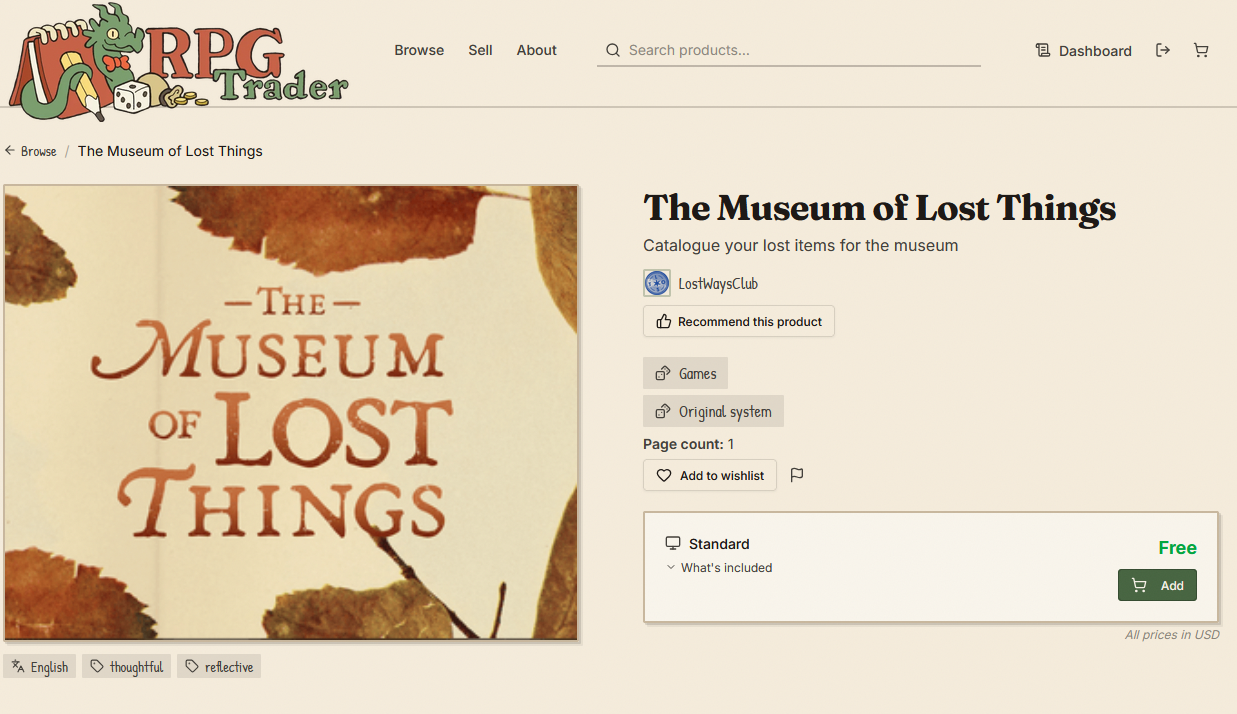
In contrast, itch.io’s discoverability options remain limited despite the marketplace’s receptiveness to indie releases. Here, RPGs are categorized under “physical games,” with titles classified by user-defined tags such as “solo RPG,” “GM-less,” and “journaling.” DriveThruRPG commands a much larger user base and product catalogue, but the latter comes with an optional exclusive distribution agreement that limits indie creators from selling their games on other marketplaces in exchange for a five percent higher payout rate. Since the base rate is by default much lower than itch.io and RPG Trader, exclusivity isn’t broadly seen as indie-friendly. This sentiment is compounded by decisions such as the delisting of Rebel Scum over its purportedly “hateful” politics, and the unpopular Partner Shipping Program, which lets publishers sell offset print books through DriveThruRPG at revenue cut of at least 30 percent.
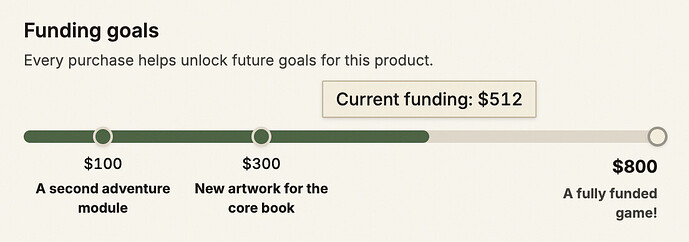
“In terms of marketplace functionality, we believe we’re in a great place and offer a lot that tabletop creators need, including some features that aren’t available elsewhere,” said Lashbrooke. “Having experience as creators and publishers ourselves has made for a great starting point as we built out the features on RPG Trader. We prioritized our core feature set for launch, and since then have added significant new features like crowdfunding fulfillment, bulk editing, better reporting [for tracking sales and other metrics], and more powerful bundle management.” RPG Trader is also reportedly working on additional features, such as the ability to switch between several major currencies and the capacity to host game jams.
One of RPG Trader’s policies that’s specifically influenced by community feedback is the platform’s anti-AI stance, which evolved from a more permissive policy that allowed for AI-generated content as long as it’s being declared, to one that explicitly rejects the sale of any games that involve the use of generative AI. In particular, one creator had pointed out in the RPG Trader forum that the prior policy doesn’t discourage anyone from using AI-generated content; some creators would simply avoid declaring it. RPG Trader eventually changed this policy, and incorporated several features, such as automated checks and human review, to actively watch out for AI-generated content within the marketplace. And if they are so inclined, creators, too, can still self-disclose if their products include AI-generated content — a seemingly counterintuitive feature that Lashbrooke stands by for now. “It’s really just there to help people have a chance to be honest and self-disclose,” he said on the forum. “I chatted to people who manage a few other marketplaces, and there’s enough anecdotal evidence to show that a toggle like this gets at least some use and helps to educate people, that it’s worth including it. If it never gets used after some time, we might just remove it.”
As a marketplace, RPG Trader doesn’t stray too far from most storefronts when it comes to payments: money is collected from buyers, and sellers can have their earnings paid out to them whenever they want. Lashbrooke said that RPG Trader doesn’t collect sales tax at checkout for now, although this may change as the platform grows and tax regulations evolve. “We monitor this closely and will update our processes as needed,” he said. “In particular, we’re keeping an eye on aligning with tax regulations in more complex markets, like the EU and US.”
But perhaps one of the most pressing concerns creators have with storefronts are payment processors. Beginning in 2025, both itch.io and Steam have been pressured by major third parties like Visa, Mastercard, and Paypal into removing games with explicit content, a decision that has disproportionately impacted queer creators; in particular, this lead itch.io eventually delisting several games. When asked about how RPG Trader will handle potential pressure from payment processors, Lashbrooke said that the team will try their best to resist these censorship attempts. Currently, RPG Trader uses PayPal and Airwallex, with Airwallex facilitating secure card transactions and bank transfers for international sellers. “If we ever get to a point where a payment processor is pressurising us to remove any kind of content, we’ll push back on it as far as we can, and potentially stop using them as a processor if necessary,” said Lashbrooke. “Our priority is the community of creators and buyers on the platform, so we’ll do what we can to support them as far as possible without removing any content.”
“In terms of marketplace functionality, we believe we’re in a great place and offer a lot that tabletop creators need, including some features that aren’t available elsewhere,” said Lashbrooke.
Launched as a public beta on June 9, RPG Trader currently offers 3,663 products by 741 creators — a rapid growth since its first five days of hosting just 83 creators and 406 products. The platform also released its first community bundle for Free RPG Day in June, with Lashbrooke sharing that the site has seen downloads and contributions across 250 creators, both of which exceeded the team’s initial expectations. “There are still lots of things we want to improve and build, but the first month has given us a lot of confidence that RPG Trader is meeting the needs of the community and that there are plenty of people eager to help shape what it becomes,” he said.
With this promising trajectory, Lashbrooke said he is dedicated to ensuring that RPG Trader remains sustainable in the long run, builds a marketplace that creators will turn to reach new audiences, and become a competitive storefront that will attract their own share of customers. RPG Trader plans to reinvest back into the platform, in addition to adding new features and creator tools and enhancing the purchasing experience. Aside from revenue, success will also be measured by creator adoption and community growth.
“Seeing more creators choose RPG Trader, watching the catalogue expand, and building an engaged community are all meaningful indicators that we're heading in the right direction,” Lashbrooke said. “We're fortunate that RPG Trader isn't under pressure to become profitable overnight.”