Talkback: Burning Wheel
The Rascal Reading Club rides again.

Listen to the latest episode in your podcast player of choice!
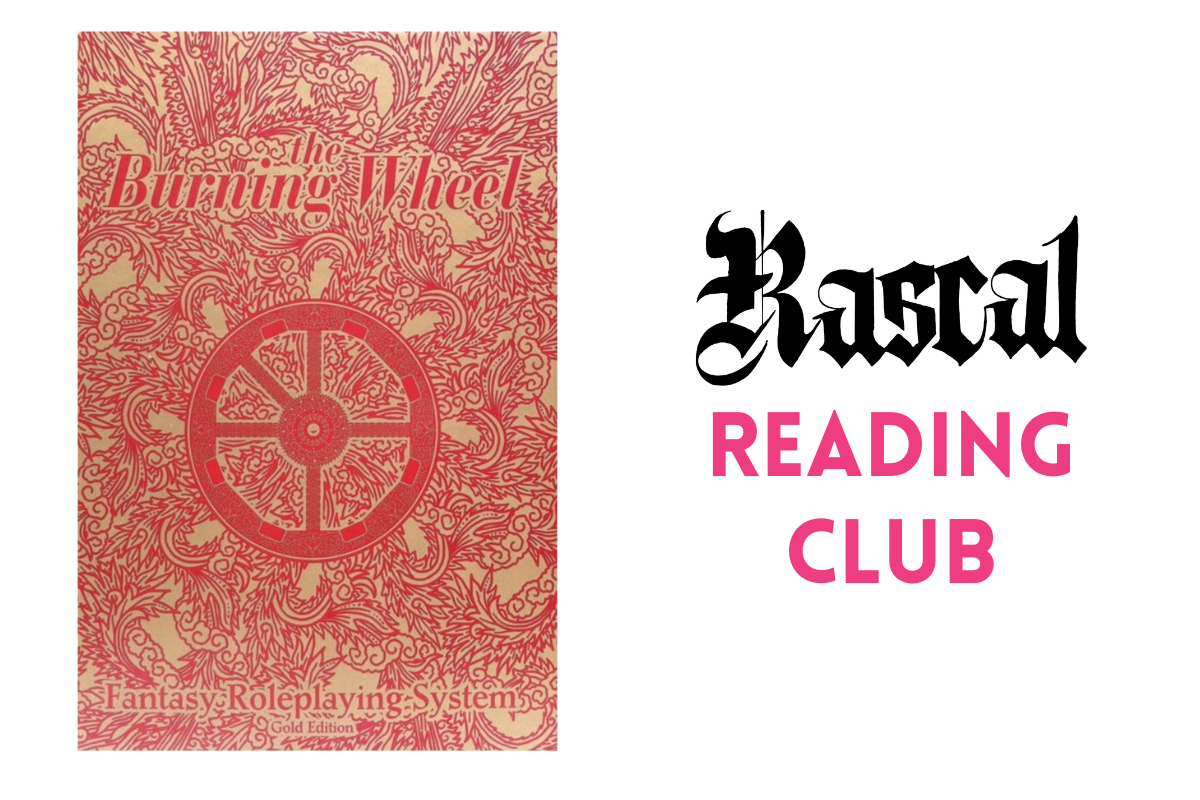
This week, Andrew Gillis, designer of Girl by Moonlight, joins me to discuss Burning Wheel and respond to listeners' responses to our discussion questions.
Excerpt:
On Burning Wheel's Theory of Power
Thomas Manuel: With Apocalypse World 2e, people complain about its language and how it's edgy, maybe they'd say macho, maybe they say argumentative, aggressive. What do you think is the difference there between those two though?
Andrew Gillis: I do think that they're very different. I think a way that I could illustrate it would be to talk about the, each game's theory of power. So in Apocalypse World, you will have moves where it's like, "Hey I'm making you do something with force" I don't decide what you do, don't have power over what you do. You are alway- power is always handed back and forth. It either it's shared evenly or I have it, I give it to you, you give it back to me. It's all, it built into the game's operations that we collaborate.
Manuel: We are often at the power of other people, right? That's a big thing.
Gillis: Yeah, you give up power in so many situations, or it empowers disempowered people, like the targets of certain maneuvers and things like that. In Burning Wheel, it's a winner takes all. If you succeed at the roll, you get exactly what you want. You tell us what happens. It's a theory of power, right? It is absolute and very blunt. And so I think that to me is the key distinction.
On internalizing systems and rules-light play
Manuel: Maybe the most honest thing I can say is that like every game I learn, I'm learning to surpass them to some extent. [But] I'm not a "rules don't matter" person, I'm the opposite because I am saying they do matter. In a very real way, they taught me something. Do you agree with that?
Gillis: Yeah, I think games shape the people that play them. They hone you into a machine for doing the thing that they're about doing. And in an ideal world, those things are then transferable and you can carry them forward to your next game, even if it's just as thoughts in the back of your mind. But also I think like from outside of games will also make you better at playing certain types of games if it's just a matter of "Oh, we're about to do a heist in Blades in the Dark. I'm gonna watch a movie that is of the same genre or whatever," right? We're always accumulating context and bits of flourish that we might put on something that we're wholeheartedly stealing from other things, right?
And so similarly from a game it's giving you a whole practice and methodology to pillage and steal from and carry on to your next game. And so yeah you carry them all with you as long as you've got a decent enough memory to retain them. And some of those will live in your bones a little bit too.
I think that's, I think that is definitely a thing that is going on. And, even at the top of the episode, we were talking about Judd's anecdote about "Yeah, I just ran it like it was Burning Wheel," is a perfect example of exactly that. I think it's absolutely a thing that games give us, and designers all have opinions about how to do that stuff.
Manuel: When I was new to role playing, I was very much a "rules matter" person because I knew that if I tried to run a game without a good system that I liked, the game sucked. I was bad at improvisation. I could not come up with interesting things. I think I couldn't make new and fun things happen. So I appreciated rule sets that, that inserted, activated, engaged and made stuff happen that I wouldn't do otherwise. So that's where I was coming from.
And now I have come down to the more nuanced thing of oh maybe I don't need that rule set to do that now.And that has given me an appreciation for all of those people who've been running games for 35 years and are actually like, "The rules don't matter." And maybe the people who were saying it in that individualized moment were being very un-nuanced, but now I'm like, oh yeah, I get it. You internalize a bunch of stuff, especially if you like only a certain kind of game and are running the same kind of — if you run fantasy RPGs and you run quest-based fantasy RPGs, and that's only what you run, of course you don't need rules anymore. You've mastered that kind of game, right? What's a rule set gonna give you if you know how to run it like the back of your hand already?