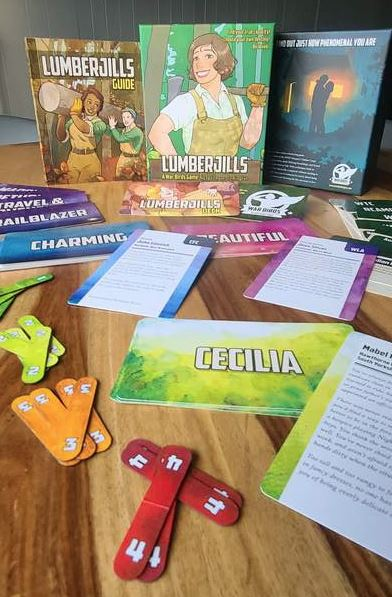
Lumberjills is a joyful homage to the Women’s Timber Corps in WW2
Sawing, dancing, and loving without prejudice.

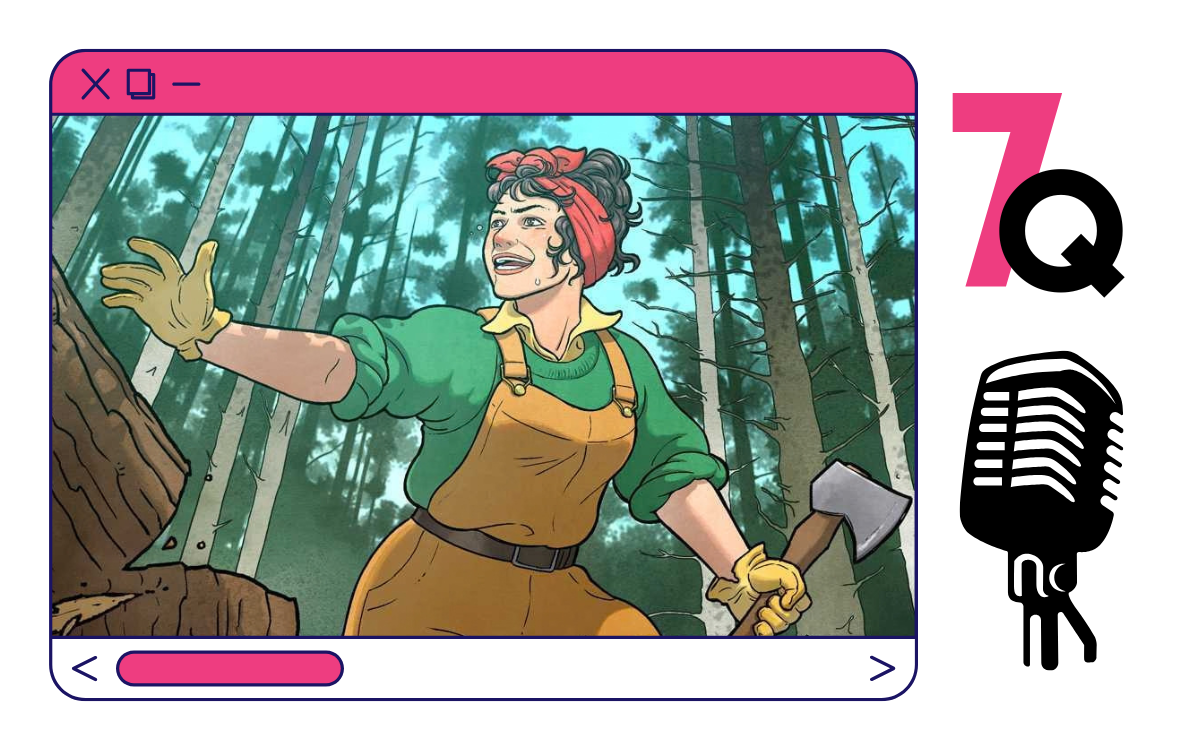
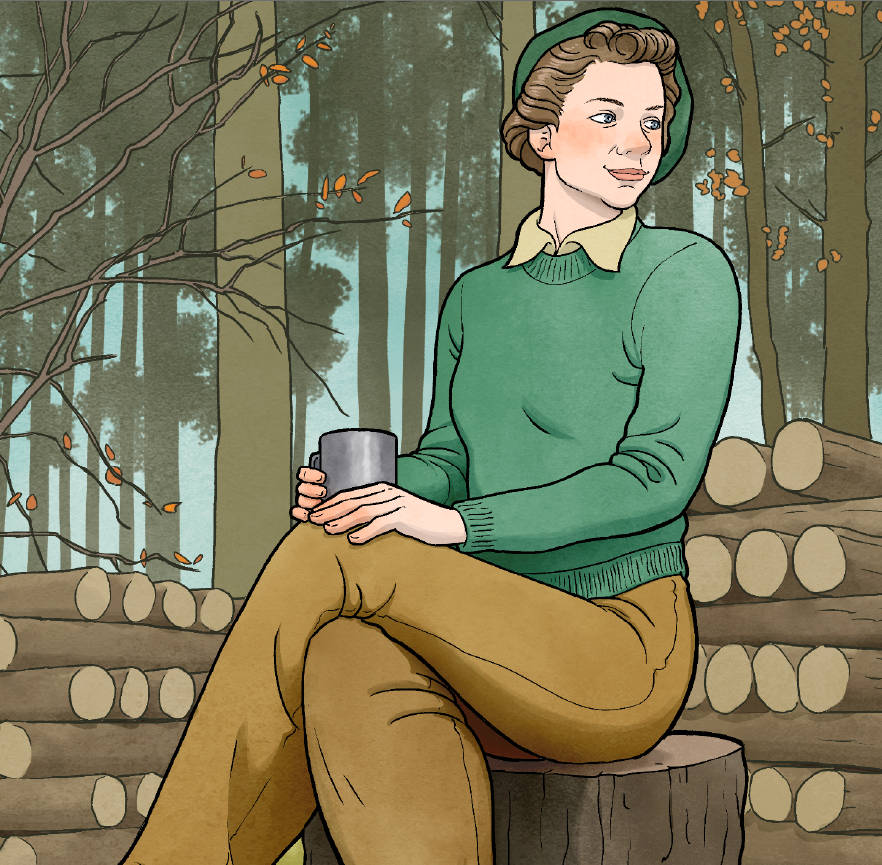
There’s an image of the lumberjill Cicely Clark from 1942 that sparked designer Moyra Turkington’s fascination with the Women’s Timber Corps. For her, it was a surprisingly authentic picture of a powerful woman, which doesn’t play into the propagandistic nature of war photography in Britain at that time. “The picture feels real, and honest to her experience. She’s got the axe slung over her shoulder like she’s on her way to work, the camera looks up to her, and she looks both a little rough around the edges and also exactly where she’s supposed to be,” said Turkington in an email to Rascal. It was also the impetus behind Lumberjills, a live-action roleplaying (LARP) game about the women from the Timber Corps. Yet the very image is nowhere to be found in the rulebook. That’s because the license of that image is owned by Getty Images — one that the company is “charging exorbitant fees” for, according to Turkington.
It’s also emblematic of the prejudice that plague the real-life lumberjills, who were women who worked in forestry operations during the war, and whose labour saw Britain producing more timber than before. Even though these were instrumental for the war efforts, the women would ultimately receive very little recognition for their efforts; they weren’t even allowed to take part in Remembrance Day parades because they weren’t soldiers (these are all details I’ve picked up while going through Lumberjills, by the way).
So while Lumberjills was crafted as a homage to these women, Turkington thought the spirit of the game should also be celebratory, and about making players feel strong, powerful and loved — just like the lumberjills were. From reading first hand accounts of the lumberjills, she discovered that while the work was backbreaking, the women adapted extremely well to their roles, while eventually remaining lifelong friends. And they weren’t just chopping down towering trees; they were also participating in dances at the lumber camps, too, where lumberjacks were vying for their attention. “There was something in the nexus of those things that spoke to everything I loved about recovering women’s history: their war work gave these women the opportunity to discover just how phenomenal they could be when the world wasn’t holding them back,” she said.
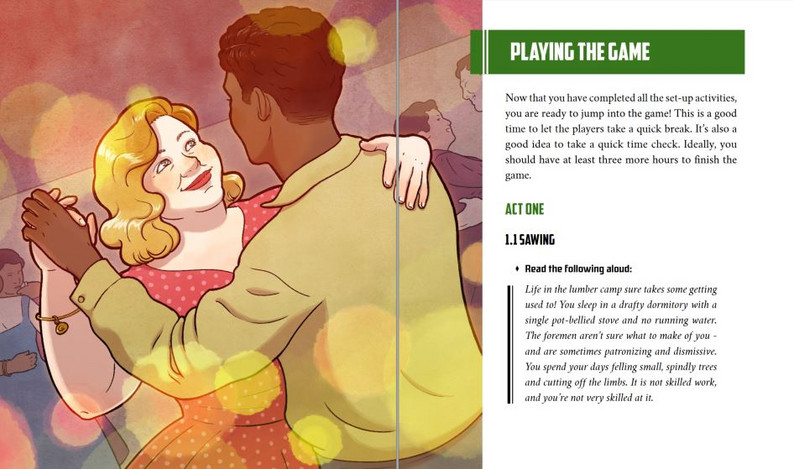
To embody the fortitude of the lumberjills, the game involves some elements of physicality, with the game split into three acts. Players get to carry out the motions of sawing wood and dancing at the camp. For the former, players get to adopt the sawing stance in pairs, which involve moving their feet and hands in unison with one another. The dance, too, works simply, with players needing to clasp their hands together as if in an arm wrestle, while placing the other hand on each other’s arms. The point is to foster a sense of intimacy through these movements, with players collaborating with one another on Spotlight Scenes, which allows them to explore their backgrounds and relationships with one another. But there’s also ample care taken to explore queer dynamics between lumberjills, if the players choose to do so, with suitors being of any genders — inspired by the queer and historical RPGs that Turkington takes ample influences from.
“For War Birds games in general, there’s a host of folks who paved the road for games that do phenomenal work with history, most notably Julia Bond Ellingboe’s groundbreaking RPG Steal Away Jordan about enslaved people in antebellum America, Tor Kjetil Edland and Hanne Grasmo’s phenomenal larp Just a Little Lovin’, and more importantly to Lumberjills itself, Edland’s short form spin off I Say A Little Prayer, both exploring sex, love, community and death in the face of the AIDS crisis in the New York of the 1980s,” she said. Then there’s Distance by Morten Jaeger, a larp from the famous Scandinavian convention, Fastaval, which is about the toil of overseas deployment on relationships. “You can see that game’s influence on the way Lumberjills calls on players to support one another’s stories and in the way that it diversifies the outcomes of the stories told among the players to make for a fulfilling combined narrative,” she said.
Ultimately, Turkington wants Lumberjills to become an empowering experience about self-discovery and joy, with players able to engage in romantically charged relationships, as well as the consent and freedom to accept, reject and negate any advances according to their comfort levels. “The game calls on every participant to lean hard in to create a surfeit of delightful options for each other,” she said. “Excitement comes from the unique joy of figuring out who you want to be and choosing for yourself. Plus it’s just phenomenally flirty and sexy and joyful — and makes players feel desired as hell.”
Responses have been edited slightly for clarity.
- If your game had walk-on music or a climactic needle drop, what song would it be?
I can never pick just one song! Here are three:
- Sing Sing Sing (With a Swing) by the Benny Goodman Orchestra, because it’s got that hook you in the gut, constant build of feelings, and a sense that everything is possible and the whole world could be yours. I also associate it strongly with my own history of dancing and romancing and discovering who I am. In the ‘90s era of swing revival, my first girlfriend and I would light the floor on fire to it.
- Dream a Little Dream of Me by Ella Fitzgerald and Louis Armstrong is one of the songs I love to use in the game itself: dreamy, romancy, period-appropriate and holds the central invitation to dream about a life you could have in the feeling of this moment of connection, which is what the game is all about.
- Shut Up and Dance, by Walk the Moon is the modern song my brain jumped to; it is the kind of song that friends and lovers gleefully drag each other up on the dance floor to. And the lyrics are all about wooing a girl, proclaiming her as your destiny, but her being absolutely, playfully in charge of how things go.
- If your game grew like a plant, what was the seed of the whole thing? And what about you made you the right kind of soil to receive and nurture that idea?
The seed was this Cicely Clark picture, and the first hand accounts of the Lumberjills. I was the right soil because I could have been one of them.
I’m not conventionally feminine; I’m an outspoken, neurodivergent, big-bodied butch. I didn’t grow up feeling attractive or particularly loveable, and I certainly wasn’t called to do any of the things the world seemed to want me to do with my life. And then, only a few months before I discovered Cicely, I had a life changing experience when I went to the woods (in Denmark) and played the larp Just a Little Lovin’. Playing it was incredibly transformative in the way that powerful immersive games can sometimes be. That game changed the way I saw myself and my relationship with the world.
When I read the stories of the Jills, that experience was still in my body, and I recognized the same kind of wild endeavour that I had just been through. I wanted to make an accessible game that gave players an opportunity to experience that.
“The game calls on every participant to lean hard in to create a surfeit of delightful options for each other,” she said. “Excitement comes from the unique joy of figuring out who you want to be and choosing for yourself."
- If your game was food, what would it be?
Thali!
I lived in India for a while, and I loved me every Thali meal I encountered. More a dining experience than a specific food, it’s a tray of small sampler dishes that aims to balance the six qualities of flavour (sweet, salt, bitter, sour, astringent and spicy) to achieve harmony in one full meal. There was something about eating a Thali meal that always filled me up early — and made me prioritize what on the tray I wanted to choose to finish. It feels a lot like the game — a harmony of the contributions of players working to create an abundance of ever-more tempting options, and a similar challenge in choosing what my character will choose to take with her, and choose to leave behind.
- If your game was a machine and we could break it down into parts, which is the smallest part that you think best captures the essence of what you're trying to do?
The somatic metatechniques. The game has metatechniques that allow players to larp doing forestry work, and to dance with other players without having to do a lot of weird miming or have any skill at dancing. I designed them through a process of iterative playstorming; trial and experimentation done live with creative friends, while repeatedly interviewing them about their levels of felt safety, comfort, confidence, intimacy and more. My goals were to dismantle barriers [around awkwardness] to enjoying these acts, to engender trust between the players to free them to lean in, and importantly to somatically support, in the player’s bodies, the narrative progression they were experiencing for their characters.
The idea of the game can be naturally daunting to a lot of players, just like the Lumberjills’ sense of being in over their heads as they go to the lumber camps. The somatic metatechniques help players have embodied reinforcement of their growing safety confidence, competence, desirability and agency, just like the Lumberjills did when they went to the woods to live deep and suck the marrow out of life, as Thoreau once waxed poetic about.
- If we broke your game down into parts, what's the thing we wouldn't see? What do you think only emerges out of the entire thing moving together?
The game has a very careful design of the character community. The Jills together create a lot of questions — they come with historical doubts, the specters of limitations that they want to escape, secret hopes and secret desires that seem impossible before becoming Lumberjills. The suitors create a bounty of opportunities who also have doubts and limitations and secret hopes — and the process of choosing and engaging with them give the Jills a myriad of potential futures for themselves.
The game gives players structure and license to introduce characters directly for bespoke desires that help them define and articulate what they want as players, as well as characters. It gives these things in staged ways — from first impressions, to intimate dances, to self-determined narrative exploration for accessibility and a feeling of building relationships that mirrors romance. And it unfolds these things in a way that offers different levels of transparency to both the other characters and their players, so that when they come together to socialize and make sense of their experiences as characters, they have built in investment, curiosity and discovery.
[What emerges is] how deeply it queers romance in the literary and cultural sense. It’s a game of romance and self determination in the 1940s that features partner dancing, so people assume it’s squarely heteronormative. It’s very not. Aside from having queer romance options built in, playing it demands and supports players to expand their understanding of gender, sexuality, and traditional participation in flirting, romance and sex. In the game you play your character, the Lumberjill, but you also play suitors for each of the other players, and the game demands that every player, madly, deeply, and with abandon, lean into wooing every other player’s character.
That means, no matter what the gender composition of your group is, everyone is going to have an embodied experience that gives them access to play something about attraction, romance, and sexuality that they’ve likely never been able to experience before, and does it in a liberatory, community supported way. You’ll pursue ardently and with abandon, you’ll be doted on and adored, your bold advances will be automatically both narratively welcome and praised! Your experience receiving attraction will feel safe, be in your own control, and with fellow players dedicated to the desires you have for your character’s future.
I designed the game, and even I was surprised when playtesting to discover how the players spontaneously described their experience in liberatory language. And I strove really hard to optimize that by building the physical mechanics of the game to reduce awkwardness, self-consciousness and friction and maximize the ease of leaning in. The game is about being seen, supported, loved and becoming, and it tries very hard to make every player feel seen, supported, loved and becoming. And I’m proud that holds true regardless of the mix of players: mixed demographic groups, groups where players were all cis, straight, and of one gender, and radically queer cohorts.
"When I read the stories of the Jills, that experience was still in my body, and I recognized the same kind of wild endeavour that I had just been through. I wanted to make an accessible game that gave players an opportunity to experience that."
- If your game had to commit a crime, what crime would it be?
From my experience as a woman designing games, I’d say that as a roleplaying crime, it’d be that it intends to give the players every last thing they ask for. And while I am making a joke about our rigid conceptions of play and games with that, I do think more broadly it is actually my real answer.
We are living at a time of increasing scarcity and authoritarian control. Scarcity of resources, time, options, connection, safety, autonomy and choice. Increasingly there is a criminalization of the desire for diversity, the assertion of our identity, to the ability to pursue our lives with agency, to the right to joy. And while I don’t think this game is going to be the grand fix to any of that, it invites players to spend some time feeling what it’s like to self-actualize, to defy expectations, and to pursue deeply human needs for connection. It asks players, even if only for the span of four hours, to work in community to make that happen for each other — to know how much resilience is built in even just a short time where scarcity just… goes away.
I don’t like to think of that as a crime, but it sure is starting to feel that way some days.
- If your game was to win an Oscar, who would it thank in its acceptance speech?
The actual women of the Timber Corps, of course. Their work, and the stories they shared that inspired me. My community of creatives that helped me playstorm the somatic sawing and dancing mechanics — particularly Misha Bushyager, Stras Acimovic, Shervyn von Hoerl, and Rachel E.S. Walton. I needed people who were willing to lean in to doing something that was undefined, intimate and vulnerable all at the same time, and to trust me as I asked questions and experimented, and they delightfully delivered. And the people who tirelessly helped me get the game out the door in a really difficult time of transition, notably: Brand Robins, Robin Scott, Alan Tobias, and Whitney Delaglio.