The unbearable melancholy at the heart of Orbital Blues
The space western RPG built on top of Bruce Springsteen and jazz.

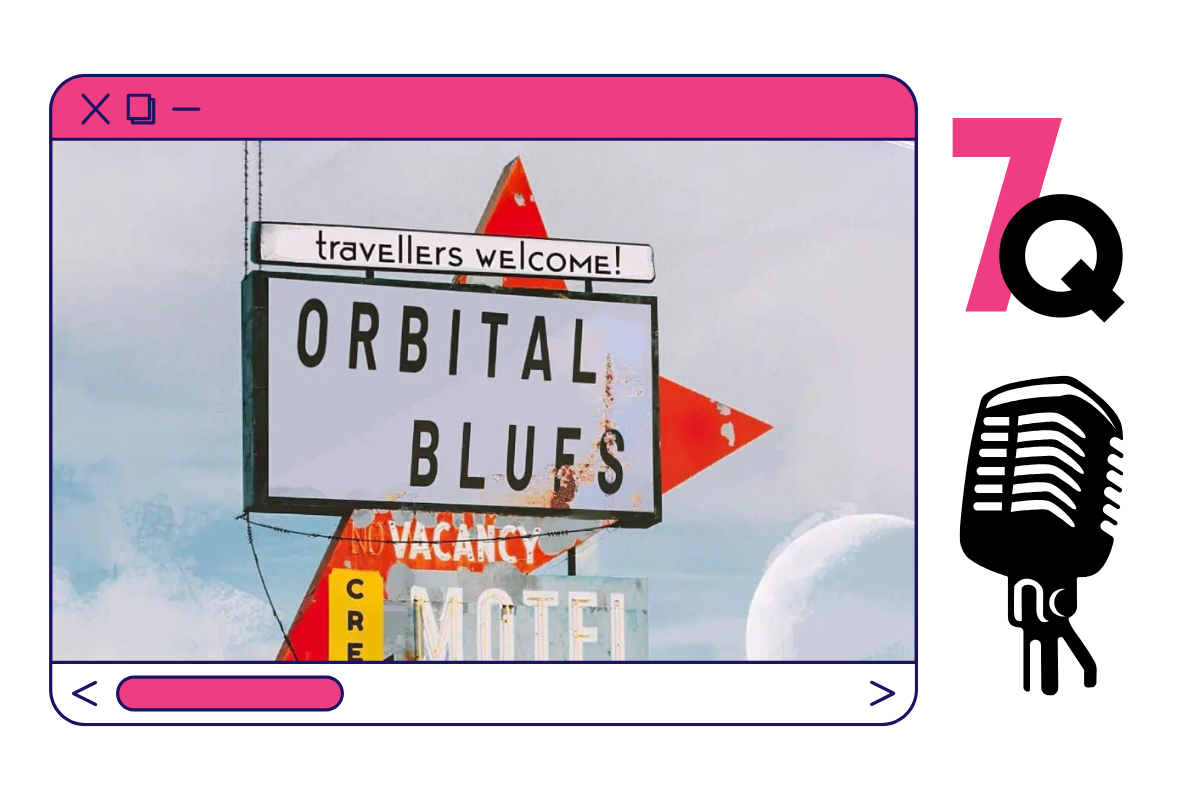
Orbital Blues is resplendently sad. You get the Blues — an actual stat in the game — when you’re struck by a wave of anguish from past grievances, guilt, or misdeeds. Perhaps this came from being a well-travelled space cowboy who has experienced firsthand the atrocities within the seedy underbelly of every planet in the Frontier Galaxy. Perhaps this was from an accidental act of violence that resulted from your own unbridled rage. Blues is the central currency for the narrative and rich storytelling in Orbital Blues; accumulating too much Blues means having too much turmoil, and you’ll need to confront the source of your interminable woes before you can proceed with your journey. It’s why Lin said that the game made them “so fucking sad”.
“I think I purged Orbital Blues out of myself like some kind of creative hairball,” said co-creator Sam Sleney in an email to Rascal. “There was a lot of mess inside of me [that] I had to get out or it was going to choke me. In itself it’s not the most original idea; it’s the Cowboy Bebop roleplaying game I always wanted as a teen, and an address of selling a little bit of yourself in employment that we all have to reckon with as adults. Those things are held together with this goo of frustration that I grew up poor and I know I’ll likely die poor too — there’s nothing coming to help.”
Want to read the rest of this piece and others like it on Rascal? Consider subscribing at any tier (even free!) and supporting independent, worker-owned tabletop journalism!
This undercurrent of melancholy begins in its in-depth character creation, a process that co-creator and director of SoulMuppet, Zach Cox, described as helping you roleplay your character to be “in line with the saddest thing that ever happened to them”. Players choose a Trouble — essentially a brief character background — and answer a series of questions and prompts, with them earning Blues as they fulfill certain conditions as they go through the game. It functions as an effective incentive for players to stick to their archetype, allowing them to flesh out their characters more while gently nudging their crew’s pensive tale across the cosmos. “I have played Traveller, and in Orbital Blues you can’t die in character creation. You can, however, get depression. In fact, you will get depression,” said Cox.
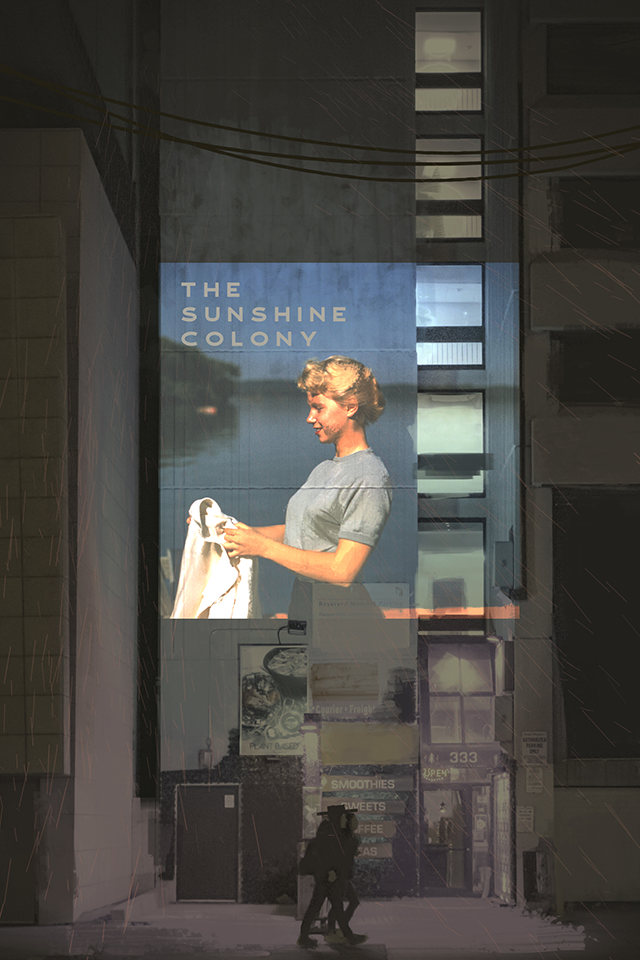
Much has also been said about the role of music to Orbital Blues; Sleney and Cox are huge music buffs, with Sleney adding that tabletop experiences should not be one of dead, awkward silences. “TV shows and movies are rarely completely quiet, and when they are, that’s also an intent,” he said. “When you’re GMing, put yourself in that showrunners’ seat and don’t just think about how something looks but how it sounds. I hope Orbital Blues is a book that you can hear.” Bruce Springsteen’s discography, particularly Born to Run through to the Nebraska eras, is his biggest influence; Sleney said that the idea of being a blue collar worker, feeling downtrodden in your circumstances, but also finding solace in the human spirit is very much the spirit of Springsteen’s music, and it’s also the genesis of Orbital Blues. And for Cox, they shared that they’re very much a jazz dude, and their influences are chiefly the sextet who recorded Miles Davis’ Kind of Blue: Davis, Bill Evans, Cannonball Adderly, John Coltrane, Paul Chambers and Jimmy Cobb.
There’s another game that Cox said they played a lot of while writing Orbital Blues: the quintessentially sad video game, Disco Elysium. “A lot of the game was my answer to how to make something in a tabletop RPG that feels like a Thought Cabinet [from Disco Elysium],” said Cox. It demonstrates that plenty of influences in both video and tabletop games are cyclical; the mechanics of Disco Elysium was, in turn, very much influenced by tabletop RPGs in the first place.
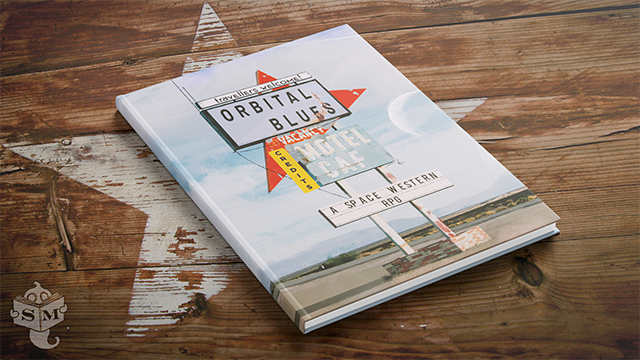
The game’s moderate success led to SoulMuppet releasing an expansion called Orbital Blues: Afterburn, which included more illustrations and adverts rendered in the game’s ‘50s retro aesthetic, a Storyteller’s Guide, and a brand new set of adventures encapsulated in a section called The Tennessee Five. Orbital Blues month, too, is currently taking place, where six third-party supplements have been written and designed for the Orbital Blues universe, including F-Infiniti, A Fistful of Stars and Paramour. “I feel incredibly lucky that so many people are so excited to play Orbital Blues, [as they] continue to support us in expanding the Outlaw Galaxy,” said Cox. “[The success is] a combination of how Orbital Blues feels and plays that allows us to compete against the popularity and grandeur of other games in the same sector, even if they’re made by bigger or more established companies.”
Responses have been edited slightly for clarity.
If your game had walk-on music or a climactic needle drop, what song would it be?
Sam Sleney, Writer: The song that always springs to mind for me and is inextricably tied to Orbital Blues in my mind is Money For Nothing by the Dire Straits. I looked into licensing it for the Afterburn trailer but it turns out the Dire Straits actually want a lot of money for that.
Zach Cox, Writer: The best bit is that you get to choose! The Swansong is the climactic moment of any campaign, where one of the characters chooses to leave the campaign (be it retiring or dying) their soundtrack plays while they perform one final scene. Elliot Davis also wrote an entire solo play expansion for Orbital Blues called The Wanderer in which you look back over the life of your Outlaw, playing poker hands and building a playlist that represents them.
My personal choice would be Blind Willie Johnson’s Dark Was The Night, Cold Was The Ground. It was played and written by a blind man on bottleneck slide guitar, with this gorgeous wordless but incredibly emotive moaning vocals. They sent it into space as part of the Voyager probe’s Golden Record. I imagine it as the sad space cowboy soundtrack during planetfall, a black and white slow motion gunfight, or our title sequence.
Joshua Clark, Artist: My choice would be When the Sun Hits by Slowdive. Blissed out and melancholic. It matters where you are.
If your game grew like a plant, what was the seed of the whole thing? And what about you made you the right kind of soil to receive and nurture that idea?
Sleney: Orson Welles said “Did poverty help my creativity? Uh, no!” and I always stand by that sentiment but in this instance, I don’t think I could have written it if I hadn’t struggled growing up and well into my adult life. Every cloud has a silver lining and all.
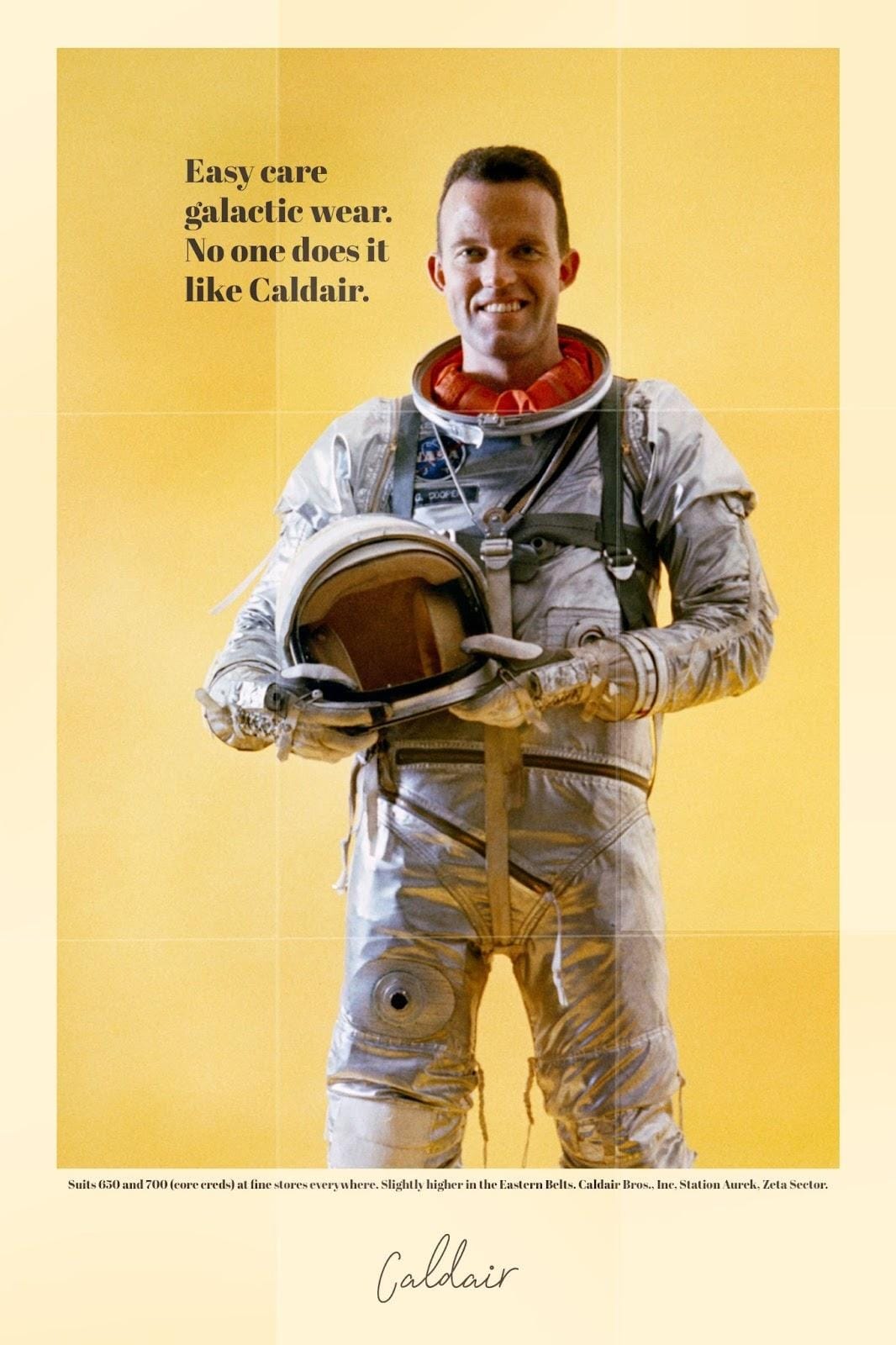
Cox: The moment that Sam pitched me the game the seed was planted. Working with Josh, Orbital Blues’ co-creator and artist, was the perfect soil. I fell in LOVE when I first saw this art piece he did in the first wave of illustrations. Easy care galactic wear. No one does it like Caldair. That was the moment my investment, involvement, and excitement stepped up from publisher and project manager to co-creator. I wonder if the real guy in the photo is still alive, or if he’ll ever know someone had an emotional reaction that strong to a photoshopped art piece of him wearing a space suit.
Clark: The seed for me was when Sam and Zach invited me aboard the project and gave me the room and freedom to build the visual language of the world of Orbital Blues. I’m always grateful for that latitude.
If your game was food, what would it be?
Sleney: Drive-thru cheeseburger and fries. Eaten on the go in the passenger seat. It's a little bit sad, but it hits the spot if it’s what you’re in the mood for.
Cox: Microwave-reheated depression lasagne. Something you made a long time ago and doesn’t look that appetising right now. You’ve had a terrible day but are too sad and tired to make something new, so you put the lasagne in the microwave and eat it and it's the best thing you ever tasted.
Clark: Greasy burgers from a C-grade restaurant chain.
If your game was a machine and we could break it down into parts, which is the smallest part that you think best captures the essence of what you're trying to do?
Sleney: Personally I think it’s the Swan Song mechanic, one of my very few mechanical contributions to the game. Play your track, do something cool, go out in a blaze of glory, dice rolls be damned. What more can you ask for?
Cox: Can I say the Caldair poster again? There is literally a Trouble called Orbital Blues, which might just be the microcosm of the whole thing.
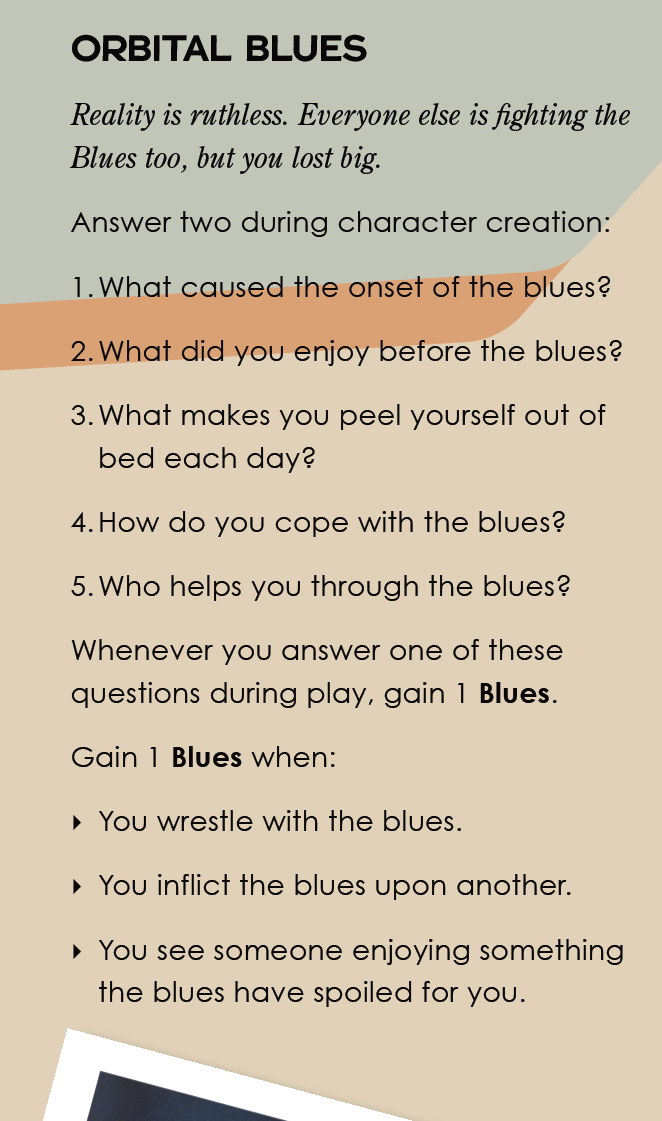
Clark: For me, the prop pack add-on for Afterburn is a distillation of everything I love about creating in the world of Orbital Blues and I think leafing through that small envelope of papers really captures the essence and feeling of the Outlaw Galaxy.
If we broke your game down into parts, what's the thing we wouldn't see? What do you think only emerges out of the entire thing moving together?
Sleney: Being different people with different takes on how Orbital Blues looks or feels as a team. To me it’s rhinestone cowboys, truckstops in space, and dive bars on dusty desert moons. It’s different for Zach and Joshua, and that makes it amorphous. It isn’t just one rigid creative vision, and I think that makes it malleable for GMs, their players and other writers to pick up and access.
Cox: I do love a discourse and I’ve been thinking about Rules Elide a lot recently. As often happens in RPGs, the manuscript obscures the true nature of our game. It's not actually about being sad or poor, the game is really a statement on found family and the love the crew of your spaceship share together, which make the unbearable bearable. The best way to play the game mechanically would be roleplaying a mess who never stops being a mess, gaining endless Blues and hitting Trouble's Brewing every session, but players never do. It doesn’t say anything about love or family or healing anywhere in the core book, but people do it anyway. It's certainly happened at every table I’ve ever played at or ran.
Clark: I think Orbital Blues is at its best when all of its component parts come together and elevate each other. The art, writing, layout and editing of the books stand strong on their own, but when they come together, they create something that would have been impossible to achieve alone.
If your game had to commit a crime, what crime would it be?
Sleney: Bank Robbery, of the heist variety. That’s almost always a stylish, salacious crime.
Cox: Grand Theft Auto: Mortgage. Missing the repayment windows on the loan for your spaceship. Orbital Blues’ money rules are desperately crushing. I am sure being poor is a crime in the Outlaw Galaxy. If that doesn’t count, duelling with laser pistols at high noon.
Clark: Petty theft, grand theft, bank theft. Any kind of theft.
If your game was to win an Oscar, who would it thank in its acceptance speech?
Sleney: Speaking as me, I’d like to thank SIXMOREVODKA and their game, DEGENESIS. It was one of the first games I ever picked up and thought, damn, roleplaying games can be slick and stylish. I want to make games like this! It’s out of print now, but it’s all available for free on their still stupidly sexy website.
Cox: Chris McDowall for being my gamedesign grandad, Spike Spiegel, Jet Black, Faye Valentine, my therapist and Mr Brown, the teacher who lead my high school jazz band.
Clark: Anyone who has cracked open any of the Orbital Blues books, taken a chance and jumped right into them.