Twenty years and two editions later, Heroes of Horror still offers scary good advice
From campaign advice to corruption, D&D 3.5e’s ghoulish guide was anything but a throwaway supplement.

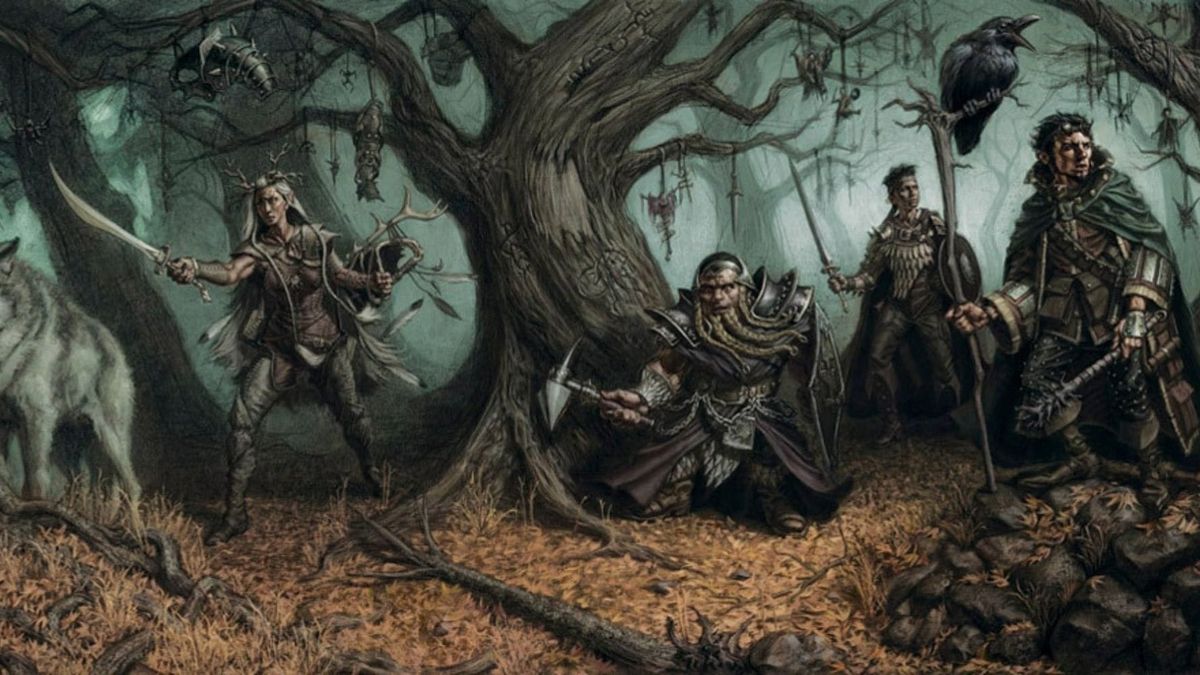
At the time of writing, we are well into the Dungeons & Dragons’ Season of Horror, one of three themes Wizards of the Coast is presenting to us this year. This first project umbrella is timed to coincide with the tenth anniversary of Curse of Strahd, itself a remake of the classic Ravenloft adventure module. Ravenloft, both the adventure and the wider campaign setting, are inextricably linked to D&D’s concept of playable horror, but WotC released a supplement for D&D 3.5 in 2005 that actively rejected Ravenloft in favor of a more broadly applicable approach to the genre. Written by James Wyatt, Ari Marmell, and C.A. Suleiman, Heroes of Horror is not only indispensable for any DM wanting to add horror elements to their D&D games of any edition, but also a worthy read for anyone interested in the blending of horror and heroic fantasy.
Ravenloft: The Horrors Within, the focus of Season of Horror, is one of only a handful of major official D&D releases scheduled for this year, supported by a handful of partnered 3rd-party material and digital tools.WotC’s output was very different in 2005: Heroes of Horror was one of 26 products released for D&D 3.5e in that year, alongside its sister book Heroes of Battle, a bevy of supporting books for the brand new Eberron campaign setting, and Stormwrack, the last of which was a supplement for running aquatic adventures both above and below the waves — I mostly remember it for introducing awesome killer whale people. On top of this, third-party production under the original incarnation of the OGL had been chugging along for years, all of which meant that sorting the wheat from the chaff was a monumental task for even avid D&D players.
D&D supplements of the era weren’t simply more numerous, either. It’s fair to say that first-party rules material for D&D 5/5.5e is highly curated, with more substantial offerings such as new classes going through multiple rounds of public testing and feedback before either making it into a new book. It treats the game as a monolith with a focus on balance and homogeneity, rather than a toolkit for the countless bespoke campaigns happening around the world. Back in 2005, designers assumed that groups would pick and choose, that DMs would use the optional rules they wanted and discard the rest. Heroes of Horror alone had two entirely new classes, six prestige classes, and a bevy of feats, spells and monsters, plus variant mechanics for dealing with fear and a new Taint system. As you’d expect, all that takes up a lot of space, clocking in at roughly two-thirds of the 150-odd pages and proving largely useless for anyone not running 3.5e. Thus, the first third of the book stands out and remains relevant today — three chapters covering fantasy horror that escalate from encounters to adventures, then to entire campaigns.
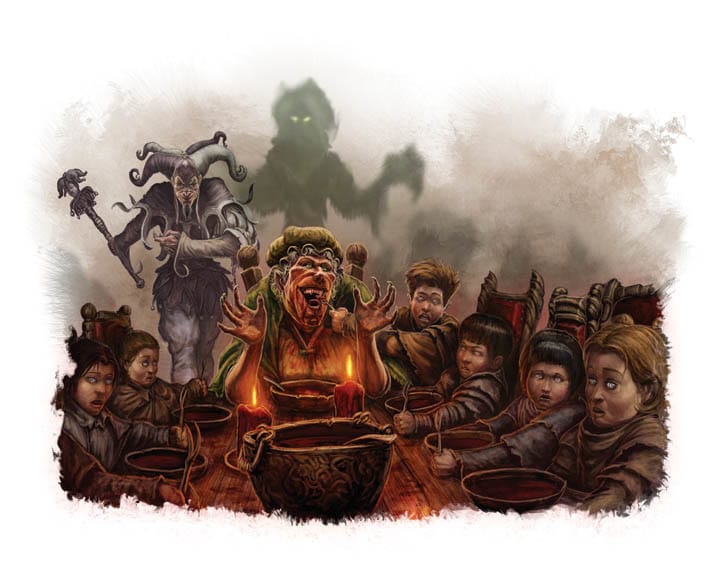
Quiet confidence pervades Heroes of Horror. It opens by making a case for adding horror elements to your D&D games that doesn’t just operate on the rule of cool, or assume that just because you’ve picked up the book, you’re already sold on the concept. Instead, it explains how the genres overlap and presents a firm thesis for the entire book. Take this early excerpt, which references how horror is woven into The Lord of Rings:
The important thing to remember about the horror is the purpose that it serves in larger stories. In the ongoing saga of the One Ring, the ringwraiths are a grim (and all too effective) reminder of what befalls men whose greed overtakes them. Tolkien was careful to make sure that every scene in which the ringwraiths make an appearance serves the greater purpose of reinforcing not only the danger of Frodo’s mission but the crucial idea that Frodo is truly the only one who can do it.
Tolkien makes the ringwraiths as haunting and disturbing as he does, in both their appearance and their tragic origins, in order to make the reader appreciate the immensity of the burden that has been placed on such a small pair of shoulders. If getting to Mount Doom were a walk in the park, the fantasy story wouldn’t pack nearly the punch it does. The horrific element adds emotional weight to the rest of the story. As the reader watches a poor hobbit trying to outwit or outrun a seemingly unbeatable foe, his own heart races in sympathetic appreciation. And when he sees the poor hobbit succeed in outwitting the terrifying foes, he recognizes that fear itself has been beaten.
This, then, is another good reason for introducing a horror encounter into an ongoing campaign. If the players are growing complacent or, worse yet, emotionally detached, then an unexpected horror sequence is a good way to shake up the game, like flinging a cup of cold water in the players’ faces. A well-paced, moody, nail-biting encounter can go a long way toward energizing player characters, or even revitalizing a group of players whose interest has waned.
It demonstrates an intimate understanding of both horror and fantasy, and how they naturally intertwine. It’s what makes Heroes of Horror broadly applicable to enhancing home games, even for those not explicitly using it for D&D. The chapters build upon themselves, and aren't afraid to revisit subjects to expand them. Horror aficionados understand that a memorable villain is the keystone of any tale of terror, so each chapter devotes a significant number of words to the topic. The villain for a single encounter has a very different role to the arch-villain of a campaign, and Heroes of Horror appropriately deals with each as a separate entity.Advice isn’t limited to campaign construction, either. Heroes of Horror discusses the need for DMs and players to be on the same page regarding the kind of atmosphere they wish to create, and the obligations they have to each other. There’s even explicit instruction for the DM not to make their players uncomfortable with any horror elements, and to stop if it occurs. It’s a brief mention and doesn’t go into any detail, but it’s a notable inclusion in a book that predates many modern RPG safety tools.
My favorite aspect of Heroes of Horror is how it treats D&D as a game outside of the explicit mechanics. Straddling the new rules and options for 3.5e, and the more general advice for running horror games, it recognises that D&D has its own set of expectations, tropes, and conventions, even outside of officially published settings. It covers how to deal with alignment, either by working around the standard assumption that good, evil, law, and chaos are immutable cosmic forces, or using a definition of alignment more closely tied to moment-to-moment behaviour than something innate. It suggests using enemies that can’t be discovered by players casting Detect Evil or similar spells, and also points out that just because someone is evil for the purposes of magic, it doesn’t mean they’re necessarily the antagonist the PCs are looking for, or even doing anything wrong.
A third option replaces spells and abilities that detect or respond to alignment with equivalents that affect Taint instead. Taint, revised from earlier versions starting with the 3e Oriental Adventures book, is a mechanic that causes PCs to become corrupted from exposure to the monsters they fight and adds layers of moral grayness that is rarely seen in a game where a simple spell can reveal whether or not someone is innately evil. Taint could be gained from the attacks and spells of certain monsters, spending too long in sites steeped in great evil, or even performing evil acts. The resulting effects could range from the mundane and all too familiar (severe joint pain, anyone?), to obvious supernatural changes, like a PC’s eyes rotting away to be replaced with points of green flame.
There are also suggestions for how to deploy classic D&D monsters for maximum horror, and how the various classes can be used as horror antagonists. (The idea of using a druid as the catalyst for a slow burn, animal-based horror scenario reminiscent of Hitchcock’s The Birds has stuck with me for two decades, even though I’ve still to try it.) It’s this specificity that makes Heroes of Horror an essential read for DMs wanting to evoke horror in their campaigns, no matter what edition they’re running, and can easily be adapted for the likes of Pathfinder and other games that hew closely to D&D.
The chapter on horror campaigns deserves special mention because it delves into a subject that is a glaring omission from many RPG books, which is what a campaign should actually look like. Instead of either providing a pre-written campaign or leaving it to the DM to figure out how to string together disparate adventures, the chapter discusses setting — including specific advice for some published D&D settings, with Ravenloft as an intentional omission — plot, and villains in fantasy horror campaigns, before providing an example outline that uses those principles and a handful of other campaign concepts. It’s an elegant approach, adding tools to the aforementioned DM’s kit, while also demonstrating how to use them. There’s also a section on dreams and nightmares, and how to use them as both plot devices and adventure settings.
Short institutional memory is a problem in RPG circles, both in terms of events and conversations, but also in where useful, good-quality writing exists in older products. It’s an issue exacerbated by new editions of games that render old material redundant. Heroes of Horror is hit by the double whammy of hailing from an old edition of D&D, but also being a supplement with a generic, albeit accurate, title. It’s a treasure trove of clear, well-reasoned advice, and deserves to be a reference for years to come. D&D 5e had a reputation for lacking in this department, but the 5.5e Dungeon Master’s Guide was a huge improvement as a resource for DMs. It would be lovely if Ravenloft: The Horrors Within could continue in this vein, giving D&D an indispensable horror resource for the modern era.